Tech solution for forestry road safety

Source: Worksafe New Zealand

Forestry roads nationwide are set to become safer, thanks to a new agreement between WorkSafe New Zealand and one of the country’s largest forest management companies.

Forest360 Limited has agreed to fund a range of actions in response to a death on one of its sites. 59-year-old Greg Stevens was killed when his logging truck and trailer rolled while negotiating a tight bend on a Coromandel forestry road in May 2023.

WorkSafe’s investigation found the design, maintenance, and risk assessment of the road by Forest360 was inadequate.

The company’s funded response forms a binding commitment, known as an enforceable undertaking (EU), which WorkSafe has accepted. It includes:

  • Funding research to develop a method to assess forestry road safety.
  • Sponsoring software development to help forest owners and operators identify unsafe road conditions.
  • Promoting the software and sharing insights with the forestry sector, including at conferences and through the Forest Industry Safety Council.
  • Forest360 will donate to education programmes through Discover Forestry, and to Wāhine in Forestry.
  • Amends paid to Greg Stevens’ widow.

“Many forestry roads in New Zealand are old and potentially unsafe, having been built decades ago to outdated engineering standards,” says WorkSafe’s Head of Regulatory Services, Tracey Conlon.

“The software development has the potential to transform how forestry roads are assessed for safety. By making cutting-edge technology accessible across the industry, Forest360’s initiatives could significantly reduce risk and save lives.”

The scene of the dramatic crash on Thames Coast Road in May 2023.

Forestry is a priority for WorkSafe as it had the highest fatality rate of any sector in 2024. Our role is to influence businesses to meet their responsibilities to keep people healthy and safe.

This is the first time WorkSafe has accepted such a commitment from the forestry sector. EUs are a way for WorkSafe to hold businesses accountable for health and safety breaches. We monitor progress on the agreed commitments and can seek a court order if they are not upheld.

Two other businesses remain before the court in relation to the death of Gregory Albert Stevens.

Read the Forest360 decision document

Find out more about enforceable undertakings

Statement from Forest360’s managing director Dan Gaddum

Forest360 deeply regrets the tragic loss of a logging truck driver employed by one of our subcontractors, who was fatally injured while operating on a forestry road under our control. Our thoughts remain with his family, colleagues, and community. We take our responsibilities for contractor safety management extremely seriously, and this incident has strengthened our resolve to lead improvement across the industry. Sometimes it’s less about dwelling on what went wrong, and more about doing something meaningful to stop it happening again.

Through this enforceable undertaking, Forest360 is investing in technologies such as LiDAR (Light Detection and Ranging), machine learning, and drone-based road assessments to better identify and manage road risks. Our goal is to deliver safer outcomes for everyone working in and around our forests, and to share what we learn to lift safety performance across the wider sector.

Media contact details

For more information you can contact our Media Team using our media request form. Alternatively:

Email: media@worksafe.govt.nz
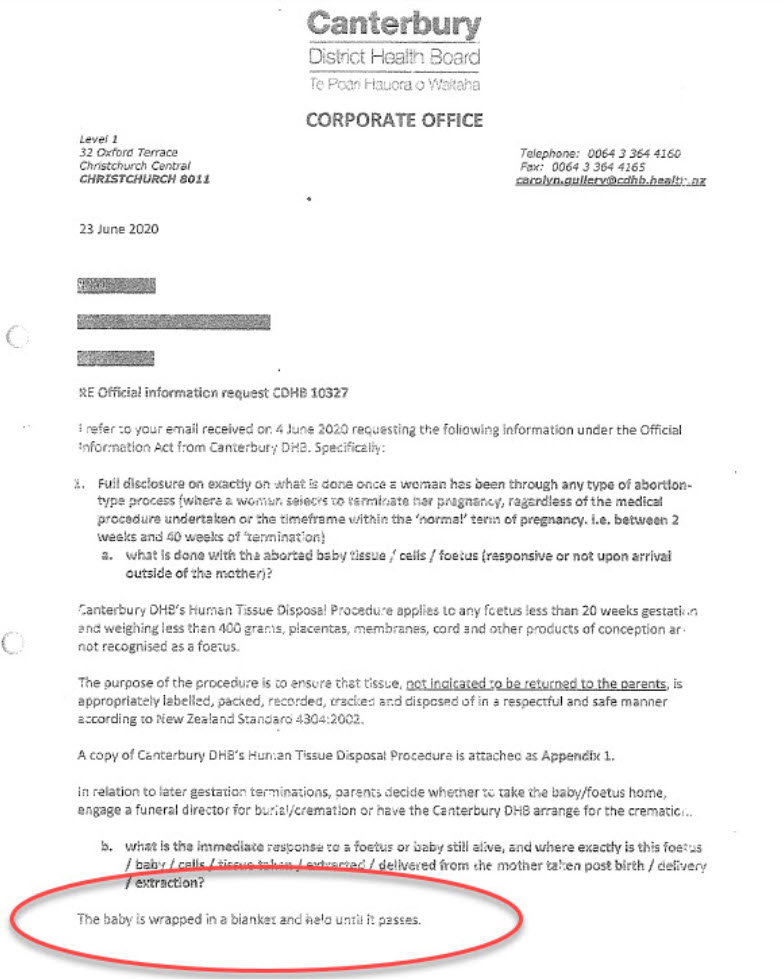
Children Born Alive After Attempted Abortions – OIA

Source: Family First

MEDIA RELEASE – 4 November 2025

Family First says that according to official government data, every month on average an unborn child is surviving an attempted abortion but is not being given life-sustaining treatment.

These shocking numbers may be well underestimated because some districts couldn’t or wouldn’t provide the data.

According to Official Information Act requests to Health New Zealand, it reveals that since the beginning of 2020, approximately 80 attempted abortions have resulted in a child being born alive but not given life-sustaining care. Gestation periods range from 20 – 30 weeks.

Disturbingly, Te Tai Tokerau district said that life-sustaining care is considered only for “wanted babies at 22 weeks + 5 days”. At Waikato, there is “parental discretion to opt in or opt out of resuscitation”. Canterbury have previously advised that the “baby is wrapped in a blanket and held until it passes”.

Some larger districts including Waitemata, Counties Manukau, Bay of Plenty, Waikato and Capital Coast & Hutt Valley refused to provide the data.

“We are not surprised by this data – but it is still truly shocking. Whether the unborn child is 15, 20, 30 or 40 weeks in the womb, it will naturally be fighting for its life. That is our human instinct. We should be protecting the lives of innocent babies who survive attempted abortions. We should be making abundantly clear that this is an obligation on medical professionals,” says Bob McCoskrie, CEO of Family First NZ.

This shocking data comes at the same time as recent studies reveal that active treatment and survival rates for babies born at 22 weeks and 23 weeks are increasing. Between 2014 and 2023, survival among 22-weekers who received active treatment rose from 25.7% to 41%. Rates of survival rose from 7.4% to 32% for babies born at 22 weeks who did not receive active treatment.

A 2025 study published by the Journal of the American Medical Association (JAMA) has revealed that both active medical treatment and the survival rate of babies born as early as 22 weeks are increasing.

In 2020, an amendment to the Abortion Legislation Bill (requiring the care of a child born after an attempted abortion) was only supported by 37 MPs (less than a third). The amendment clarified that a qualified health practitioner who performed an abortion that results in the birth of a child after an attempted abortion has a duty to provide the child with appropriate medical care and treatment, no different than the duty owed to provide medical care and treatment to any other child born.

“The vote against such a provision was actually just confirmation of how extreme and radical Jacinda Ardern’s abortion law was – and the agenda of its supporters.”

At the time of the debate in Parliament, then-Minister of Health & Labour MP Andrew Little saidI would like to see the science about a child being born after an abortion.”

“Here is the evidence. This is not about politics – this is about having a heart,” says Mr McCoskrie.

Based on this disturbing evidence, Family First is calling on the Government to immediately introduce and pass legislation which requires life-sustaining care of any child born alive after an attempted abortion.

Family First is also questioning why this data is being withheld from some districts, and is calling on the Ministry of Health to keep more accurate and transparent information about these occurrences.

Police seize $12m of cocaine stashed inside container

Source: New Zealand Police

Police have seized 36 kilograms of cocaine this afternoon, after its discovery stashed inside a container delivered to an Auckland business.

An investigation is now underway to locate the criminal syndicate involved in the importation.

Detective Senior Sergeant Jason Hunt, from the National Organised Crime Group, says unsuspecting workers made the discovery today.

“Staff working at the Auckland premises were going about unloading legitimate goods shipped from Brazil when the cocaine was discovered,” he says.

“It was in bags on the top of the legitimate product in the container.”

Police were contacted and detectives from the National Organised Crime Group were soon on site, seizing 36 kilograms of cocaine.

Detective Senior Sergeant Hunt says the seizure is worth around $12.6 million.

“This is a prime example of a ‘rip on’ or ‘rip off’ importation to try and sneak drugs into New Zealand,” he says.

“It’s a common method used by criminal groups where they exploit the bona-fide details of a legitimate company’s import.”

Police enquiries remain in the very early stages.

Detective Senior Sergeant Hunt confirms New Zealand Police will work with overseas law enforcement agencies as part of the investigation.

“I acknowledge the staff for doing the right thing and it’s great to have this product seized before it reached New Zealand communities.

“For context, removing this amount of cocaine from the market may have prevented up to $13m worth of social harm to the country.”

ENDS. 

Jarred Williamson/NZ Police

Media note: Police is releasing three images, attached to this media release.

Express lane for new supermarkets underway

Source: New Zealand Government

The Government has today introduced the Fast-track Approvals Amendment Bill, creating a consenting express lane for new supermarkets.

Economic Growth Minister Nicola Willis says the Bill creates a new fast-track consent option for new supermarkets that would improve grocery competition.

“Our goal is a more competitive grocery market that delivers better prices and more choice for Kiwi shoppers. 

“Potential supermarket competitors have told us that standard resource consent processes can hold them back; with restrictive local zoning and lengthy approval processes adding cost, complexity and delay before new projects can get off the ground.

“The Fast-track Bill will allow new supermarket developments to bypass the standard lengthy resource consent process and instead be referred by the Minister for Infrastructure to a fast-track expert panel for a quicker decision. 

“This will simplify what can be a years-long process into one that could be wrapped up in a few short months.”

“To qualify for this express treatment, projects will have to demonstrate how they align with the Government Policy Statement on grocery competition, which accompanies the Bill being introduced today. 

“The policy statement makes clear that this express lane option is targeted at supporting the entry and expansion of firms that can challenge the dominance of existing major grocery retailers and offer genuine choice to consumers.  

“This could include formats currently under-represented in New Zealand including supercentres, limited assortment stores, and multi-site developments.

“The competition statement states that projects from the dominant incumbent grocery players – Foodstuffs North Island and Foodstuffs South Island and Woolworths – would only be considered for fast-track referral in very limited circumstances where they can demonstrate a specific project would not reinforce their existing market dominance but would, for example, bring consumer choice to an underserved region.

“This Bill is an important step forward in the Government’s work to roll out the welcome mat for new supermarket competitors, boost competition and deliver better deals for Kiwi shoppers.”

Minister for RMA Reform Chris Bishop says the Fast-track Amendment Bill clarifies and further streamlines the Fast-track Approvals Act for even greater efficiency.

The Fast Track Approvals Act is generally working well, with four projects already consented (Port of Auckland’s Bledisloe North Wharf and Ferguson North Berth Extension, Maitahi Village development in Nelson, the Milldale development in the Auckland suburb of Wainui and the Tekapo Power Scheme reconsenting). There are 24 substantive applications currently in train at various stages with five more decisions due by Christmas 2025.

“The Bill introduced today makes a series of technical changes to improve the efficiency of the Act and to cut project application processing times.

“The Bill includes a small but important correction to Schedule 2 to ensure the Stella Passage at the Port of Tauranga, that was agreed by Parliament, is accurately described to align with that project’s scope.

“Over the last few months, the expert panels and panel conveners, applicants, government officials, and councils have identified areas where improvements could be made to the Fast-track regime, many of which are reflected in the Bill introduced today.

“Officials estimate the amendments introduced in this Bill could reduce the combined processing and consideration times by six weeks or more.

Regional Development Minister Shane Jones says the simplification of the consenting process for potential new entrants in the supermarket sector is great news for regional New Zealand.

“Kiwis who live in the country’s smaller centres are often the most impacted by a lack of grocery retail competition. These changes will make it easier for supermarkets to set up shop, bringing down prices for people working hard to put food on the table for their families.”

“The changes being made to the fast-track are a sensible response to the teething problems that have arisen from time to time in this early stage of the Act. The Government will take particular note of submissions through select committee, to ensure that all sensible efficiencies in the process are being made.

“I’m confident that as the legislation beds in, and both officials and the public become more comfortable with the pace at which decisions are being made while staying within guard rails, the fast-track will really show its value for Kiwis through jobs, regional prosperity and economic growth.”

The Government’s intention is for the Bill to be referred to the Environment Select Committee for scrutiny after its first reading in Parliament on Thursday 6 November and for the Bill to be passed before the end of the year.

Note to editor:

The Government has released the draft Government Policy Statement to help the sector identify which projects are likely to be eligible for the fast-track process. The draft Government Policy Statement will be formally issued subject to the passage of the Fast-track Approvals Amendment Bill. It is not yet in effect and does not carry any legal weight in respect of decisions being made on current applications.

More information on the Government’s grocery work programme is available here.

Attached: Draft Government Policy Statement – Grocery Competition

Geotechnical work about to begin for State Highway 1 Wellington improvements project

Source: New Zealand Transport Agency

Drills will be in the ground shortly with investigation work set to begin on one of Wellington’s biggest infrastructure projects.

Geotechnical works for the State Highway 1 Wellington Improvements Roads of National Significance (RoNS) project are due to begin from Monday, 10 November, and are scheduled to finish in January 2026. The drilling work will be undertaken on the Hataitai side of Mount Victoria, within the Wellington Town Belt.

Kesh Keshaboina, Regional Manager System Design, says some recreational tracks used by walkers and bikers in the area will have to be temporarily closed so that the work can be completed safely. “We will need to drill five boreholes between 40 and 80 metres into the ground to obtain geological core samples as part of the ongoing planning for this project.”

“It is critical that we get an accurate picture of the local geology, as this will help us to plan the alignment and develop the design of the proposed second Mount Victoria Tunnel. The core samples will provide valuable information, critical for the project’s success, Mr Keshaboina says.

He says, to manage safety risks, it is important that people are kept clear of the drilling sites while the work is underway.

“We appreciate that the Mount Victoria tracks are well-used and well-loved by many in the community, but it is simply not safe to have tracks open at sites where drilling is planned. We are asking people to bear with us while we complete this essential work.”

“This work is temporary, and full access will be restored to the affected tracks and paths as soon as it is completed,” Mr Keshaboina says.

He says every effort will be made to reduce impacts on the public and NZTA/Waka Kotahi will keep people up to date on the work.

“Work will be underway at multiple sites simultaneously to ensure the investigations are finished as quickly as possible.”

“Signs will be in place on closed tracks, and on feeder tracks, to ensure that people know exactly which areas can and cannot be accessed. The most up-to-date track closure information will always be available on the project page on the NZTA website,” Mr Keshaboina says.

More information

Police investigating arson and other offending at Ōrewa businesses

Source: New Zealand Police

Police have commenced an operation on the Hibiscus Coast into a fire deliberately lit at a cafe over the weekend.

It comes as Waitematā North CIB continues to investigate another attempted arson and damage at nearby Ōrewa businesses in recent months.

Waitematā North Area Commander Inspector John Thornley says the most recent fire occurred late on Saturday 1 November.

“Operation Governor has been set up to investigate the most recent fire on the main strip in Ōrewa,” he says.

“It’s fortunate that no one has been harmed as a result of this fire, which is considered to be deliberately lit.”

Residents can expect to see a larger Police presence around Ōrewa over the coming days.

“I want the community to know that these attacks on local businesses won’t be tolerated and we are working hard to hold those responsible to account,” Inspector Thornley says.

“These arsons are not only damaging property, but it’s affecting peoples’ livelihoods, and Police is open-minded about whether any of these incidents are linked.”

It’s highly likely the community’s information may prove pivotal in this investigation.

Inspector Thornley says the investigation team will be engaging with the public over the coming days.

“We want to hear about any suspicious activity that people might have seen on Saturday night,” he says.

“I’m asking anyone with dashcam footage around the Ōrewa township, between 10pm and midnight, on Saturday 1 November to make themselves known to the investigation team.

“No piece of information is too small, so please come forward as soon as possible.”

Anyone with information can update Police online now or call 105 using the reference number 251102/4265.

Information can also be provided anonymously via Crime Stoppers on 0800 555 111.

ENDS.

Jarred Williamson/NZ Police

Road blocked, SH 5, Whakarewarewa

Source: New Zealand Police

Road blocked, SH 5, Whakarewarewa

A truck crash has blocked State Highway 5 at Whakarewarewa, south of Rotorua this afternoon.

The crash occurred when a truck and trailer carrying logs overturned between Waipa State Mill Road and Eight Mile Gate Road, about 3.30pm. The driver reportedly suffered minor injuries.

The road is fully blocked, and traffic management is being arranged. Diversions are in place on Tumunui Road and State Highway 30. 

Motorists should expect delays while the scene is cleared.

ENDS

Issued by the Police Media Centre

Fast-track renewable energy project green-lit

Source: New Zealand Government

Infrastructure Minister Chris Bishop and Regional Development Minister Shane Jones have welcomed the approval of the first renewable energy project under the Fast-track Approvals Act. 

Genesis Energy Limited lodged an application in April 2025 to continue operating and maintaining the Tekapo power scheme, which includes Tekapo A and B power stations and substations, and the canal system.  

“Genesis Energy initially applied for a standard RMA resource consent in July 2023. A year into the process, Genesis indicated that further delays were likely due to the council hearing process and the potential for appeals. Genesis then applied for fast-track on April 2025, with the process taking just 80 days once a panel was appointed,” Mr Bishop says. 

“Today’s approval follows the approval of the Port of Auckland expansion, Maitahi Village development in Nelson, and the Milldale development in Auckland. I’m pleased to see the system delivering approvals in key areas and giving the large infrastructure projects New Zealand needs certainty.” 

Mr Jones said the Tekapo project was a great example of the Act doing exactly as it should, speeding up consenting for vital infrastructure.

“The Tekapo power scheme generates enough clean electricity to power more than 228,000 Canterbury households, and it plays a vital role in keeping our grid reliable.

“There is absolutely no reason why such important projects should stay tangled up in red tape and economic progress should be constricted by bureaucratic nonsense.

“I’m looking forward to more applications going through the fast-track process to create jobs, regional prosperity and much-needed economic growth for New Zealand.”

The Ministers are currently working on legislative changes to speed up the fast-track process, iron out problematic areas and get projects under way even faster. 

Editors note: 

  • More information about the project: Tekapo Power Scheme – Applications for Replacement Resource Consents
  • Genesis Energy Limited lodged a substantive application for the project on 11 April 2025. 
  • The panel was appointed by panel convener Jane Borthwick and commenced on 14 July 2025.
  • The draft decision was issued by the panel on 6 October 2025. 
  • The panel’s final decision can be appealed to the High Court on a question of law.
  • Panels make the decisions to approve or refuse consents and whether to impose conditions. 

Fast-track projects to date  

The Fast-track Approvals Act contains a list of 149 projects which, from 7 February, 2025, have been able to apply for consideration by an expert panel.  

Projects not listed in the Act can also apply for referral into the fast-track process.  

Projects approved by expert panels:   

  • Bledisloe North wharf and Fergusson North Berth Extension (Infrastructure) 
  • Maitahi Village (Housing) 
  • Milldale – Stages 4C and 10 to 13 (Housing)  
  • Tekapo Power Scheme – Applications for Replacement Resource Consents   

Expert panels have been appointed for:   

  • Sunfield Masterplanned Community 
  • Drury Metropolitan Centre – Consolidated Stage 1 and Stage 2 
  • Waihi North 
  • Kings Quarry Expansion – Stage 2 
  • Drury Quarry Expansion – Sutton Block 
  • Taranaki VTM Project 
  • Ryans Road Industrial Development 
  • Rangitoopuni 
  • Homestead Bay 
  • Stella Passage Development  
  • Pound Road Industrial Development 
  • Green Steel 
  • Arataki project 
  • Ashbourne  
  • Takitimu North Link – Stage 2  
  • Ayrburn Screen Hub 
  • Southland Wind Farm  

Projects currently being assessed prior to panel appointment  

  • Waitaha Hydro 
  • Haldon Solar 
  • Waitākere District Court – New Courthouse Project 
  • Kaimai Hydro-Electic Power Scheme 
  • The Point Solar Farm  

18 projects have now been referred into the Fast-track process by the Minister for Infrastructure.   

EU – NZ Business Summit speech on Science, Innovation and Technology

Source: New Zealand Government

Good morning everyone. 

Today, we celebrate the welcoming and deepening partnership between New Zealand and the European Union. 

I want to acknowledge Commissioner Maroš Šefčovič , Prime Minister Christopher Luxon, Ministerial colleagues, EU Ambassadors, and all our guests from Europe and New Zealand. Thank you for joining us.

I want to talk about science, innovation and technology.

New Zealand and the EU are close, like-minded partners, united by shared values, and a commitment to science and technology for a better future. 

Our researchers collaborate on health, environment, advanced technologies and agriculture – tackling shared challenges together. 

These partnerships are possible because of the dedication of our people and institutions, supported by our governments – and there are always more opportunities to collaborate. 

What is also true, is that New Zealand’s association with Pillar 2 of Horizon Europe has taken our partnership to a new level. 

We are proud to be the first country outside of Europe’s immediate neighbourhood to join. 

Already, New Zealand researchers are involved in 20 Horizon Europe projects, with a success rate matching our European peers – proof of the value placed on New Zealand science.

Our collaboration is delivering real-world impact. Today’s “innovation spotlight” videos showcase joint advances in AI for healthcare, plant health, and sustainable textiles. 

With the recent establishment of New Zealand’s new Bioeconomy Science Institute as part of our science reforms, we have created the second largest bioeconomy research institute in the world. 

New Zealand’s biodiscovery sector brings further unique strengths to this partnership. 

New Zealand has 80,000 indigenous species, and only 35,000 have been scientifically described. 

Somewhere in those 80,000 may lie the next cancer drugs, the next nutraceuticals, and the best part is we have a head start with indigenous knowledge and a multibillion-dollar Māori economy. 

That’s why we recently announced $42 million for a biodiscovery platform, to be led by the Bioeconomy Science Institute, to support the commercialisation and growth of New Zealand’s already strong and diverse biodiscovery sector – which includes organisations such as the Maurice Wilkins Centre for Molecular Biodiscovery.  I want to reflect on the name of that institute for a moment.

If I say to you all, who discovered DNA, the template for humanity and structures, you will likely say to me Watson and Crick, Nobel Prize 1962. Actually, the 1962 Nobel Prize for discovery of the structure of DNA went to 3 people: Watson, Crick, and New Zealander Maurice Wilkins. 

Meteorologists are telling us that the wind and rain that battered New Zealand this week is due to an Antarctic weather pattern in Antarctica last month. Antarctica matters to all of us.

Christchurch in the South Island is one of only five Antarctic gateways, and indeed is a gateway to Antarctica for several European countries.

We are investing in our Antarctic Science Platform to support science, amongst other things, on the impact of climate on Antarctica, including the Ross Ice Shelf, which, if it melts as part of the West Antarctic Ice Sheet, will raise sea levels for all of us by three to five metres. Antarctica is a unique and fertile platform for collective science endeavours, and New Zealand has both a gateway, and science facilities at Scott Base. We’d welcome your further interest and collaboration.

Others will speak in more detail during the forum, but as the Prime Minister noted, since Rocket Lab’s first orbital launch in 2016, New Zealand has become the world’s third busiest commercial space launch site, and we aim to double the sector in the next five years. 

So, we can get to space, and once there we can also do stuff. New Zealand’s Robinson’s Research Institute in collaboration with Victoria University of Wellington currently has the world’s first ever, high temperature superconducting magnet bolted on to the outside of the International Space Station. The next step in energy dense super conduction.  

It’s that expertise that supported our $71 million investment in Robinson Research Institute, for a new science platform dedicated to future superconductive magnetic and materials technologies. 

Like a few places in Europe, noticeably Iceland, New Zealand also has an area in the middle of the North Island, where the earth’s crust is thin, and coincidentally where the world’s second ever geothermal energy plant was constructed in 1958. 

We already have 80 to 85 per cent renewable energy, but to power the huge data centres Microsoft, Google and others want to build here, quite simply, we need more. 

So, as a Government, we have recently committed tens of millions of dollars to drill down four kilometres, to hit supercritical geothermal energy. This then is an invitation to join us on that exploration, and together to crack open that renewable energy source that is so tantalisingly close to commercialisation. 

To summarise, opportunities for collaboration in space, quantum, geothermal energy and AI are expanding. 

New Zealand also now has access to Horizon Europe’s restricted calls in these areas, and I encourage our collective researchers to seize these opportunities. 

To our European friends: New Zealand is open for business and science partnerships, from advanced technology to agritech, from Antarctica to space, from geothermal to foiling America’s Cup boats.

Like Europe, we want to back science that will shape our future industries, build skills, and turn innovation into real-world products.

In conclusion, New Zealand may be small, but we punch above our weight, we are good partners, and we have some geographic advantages that we want to share with you.

Our collective success depends on strong global partnerships – like those we celebrate today. I hope you make valuable connections at this summit and throughout your visit.

Thank you for your commitment and collaboration. 

Appointments to Primary Care Advisory Group

Source: New Zealand Government

Health Minister Simeon Brown has today announced appointments to the new Primary Care Advisory Group, which will provide specialist advice to help shape the future of primary care.

Dr Bryan Betty has been appointed as Chair of the new advisory group. Dr Betty brings extensive experience as a general practitioner and is the chair of General Practice New Zealand. Dr Samantha Murton, who has significant clinical leadership and governance experience, has been appointed Deputy Chair.

The other appointed members of the advisory group are:

  • Penny Clark
  • Dr Jo Scott-Jones
  • Dr Steven Young
  • Dr Kate Baddock
  • Dr Stephanie Taylor
  • Darryl Jhinku

“These members bring a wide range of expertise, which will help strengthen the role of primary care and ensure it makes the greatest possible impact on New Zealanders’ health,” Mr Brown says.

“The Government is committed to making high-quality, timely healthcare accessible in every community. We have delivered record investment in primary care and launched initiatives to grow the GP and primary care workforce.

“The advisory group will provide expert guidance from primary care leaders, ensuring these investments translate into real improvements in health outcomes for New Zealanders.

“While the group will initially focus on general practice, its work may expand over time to include other healthcare delivered in community settings.”

All terms of office will commence on 3 November 2025.