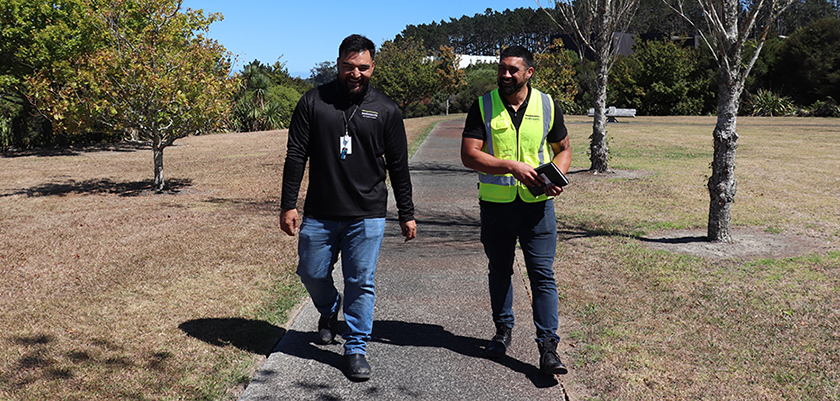
WorkSafe New Zealand has opened its first intake of health and safety inspectors for 2025, and is keen to hear from anyone with an interest in making work safer in Aotearoa.
Inspectors are our frontline eyes and ears across the motu. We are adding up to 60 new recruits this year, each of whom will get full training and development.
This is an opportunity for people starting their career, looking for a change of career, or considering a meaningful way to repurpose their existing skills. You’ll need to be communicative and resilient, have an inquiring mind, and be an effective problem solver.
“We are currently integrating the full range of assessment and investigation work in our inspectorate. This will create a supportive training ground for our incoming inspectors to springboard from,” says WorkSafe’s Head of Inspectorate Rob Pope.
WorkSafe is investing an extra $2.7 million annually into growing its inspectorate. This is part of our new strategy to target the sectors with highest work-related harm – construction, manufacturing, forestry, and agriculture. While a background in these sectors would be highly advantageous to working for WorkSafe, it is not essential.
WorkSafe is the health and safety regulator for work in New Zealand. Our role is to influence businesses to meet their responsibilities and keep people healthy and safe.
This technical bulletin provides guidance about the work trainee divers may undertake while under direct supervision during occupational diving operations.
Introduction
WorkSafe New Zealand requires applicants to provide dive logs to support their Certificate of Competence (CoC) application.
WorkSafe has recently seen an increase in divers submitting dive logs that indicate a need to make clear the distinction between a ‘diver under training’ and a ‘diver working without a CoC’.
This technical bulletin clarifies recommendations for divers who do not hold a current CoC as an occupational diver, but who are doing training dives while at work.
Background
The Health and Safety in Employment Regulations 1995 (the Regulations) require occupational divers working for a Person Conducting or Undertaking a Business (PCBU) to hold a CoC in the category in which they are diving. The CoC is issued by WorkSafe.
The Regulations have a provision allowing workers to undertake training to become the holder of a CoC, but require diving ‘under the direct supervision’ of another diver who holds a CoC for that category of diving.
WorkSafe defines direct supervision as being ‘within reach or contact at all times to ensure immediate assistance can be provided if necessary’.
When is a diver under training?
If a diver does not hold a current CoC, they must be under the direct supervision of a current CoC holder while diving is taking place. In this case they are considered a ‘trainee diver’.
As with all trainees in the workplace, supervision is required because they do not yet meet the necessary level of competency to operate independently in the workplace. For divers, this level of supervision is higher than expected in other workplaces.
Students undertaking formal instruction on a diving course (for example, Australian Diver Accreditation Scheme, Professional Association of Diving Instructors, and Science Diving New Zealand) are not working and do not require a CoC under the Regulations providing all the diving is in accordance with the course syllabus and supervised by a suitably qualified trainer holding a CoC.
But if they begin work tasks outside of their dive course (for example, leading dives, taking samples, fixing nets, cleaning aquariums or being a safety diver) they are considered to be working and will be seen as requiring a CoC.
What sort of training can be undertaken?
While the Regulations allow for employees to train to become a holder of a CoC, the Health and Safety at Work Act 2015 (HSWA) requires a PCBU to ensure the reasonable safety of all workers, including those under training.
Before conducting any trainee diving, a PCBU must ensure that the minimum diver level pre-requisite competency has been met, and the trainee divers are competent to learn the specific tasks required for that category of CoC. This includes the use of the diver’s breathing equipment and any hazardous powered tools – both of which should be taught in a formal diving course before use in any workplace.
As trainee divers are learning, PCBUs must also consider both the environment and duration of the training as well as competency levels. Dive sites should be assessed to be of low risk, close to appropriate surface and emergency support and in an environment where the focus is on the work skills being taught, not the hazards of the actual dive site. Remote and isolated sites are not recommended.
Further, being a ‘trainee diver’ should be time limited to ensure the diver has an expectation of how long it will take to achieve competency in the assigned work skills and be able to be assessed for all the skills learnt. Most trainee divers should be able to effectively show competency within a few weeks or months, depending upon the complexity of diving and skills required. In any case the trainee period should be limited to six months at maximum, unless there are exceptional circumstances.
What is not considered training?
A trainee diver cannot fill the role of a standby diver – any standby diver must be able to immediately come to the working diver’s assistance, and as such must already hold a suitable CoC. Performing the role of a standby diver is not considered training.
Even though a trainee diver may be considered the CoC diver’s ‘buddy’ when diving, they cannot be counted as an extra ‘working diver’. Doing so without having separate direct supervision may not be considered training and could indicate the diver is working without a CoC.
Dive logging as a trainee diver
It is expected practice that trainee divers log any supervised dives as training dives to achieve a competency requirement or qualification. This practice is clearly undertaken in a formal course environment and should be replicated by all divers under training.
All normal dive log details should be recorded (such as date, location, depth and time) along with details of their supervising diver, other divers in the team as well as the competencies and activities being undertaken. The logs of training dives should then be submitted as part of their CoC application.
Any dives not directly supervised are not considered training or suitable recent experience for the trainee diver and could indicate that the diver may have been working without a CoC.
Medicals for trainee divers
The Regulations require that occupational divers be ‘medically fit’. Due to the health and exposure risks associated with occupational diving, any trainee diver should be medically assessed and hold a diving medical clearance prior to undertaking any training dives under supervision.
Recommendations
The competency requirements for the relevant categories of CoC are the minimum standards for an occupational diver in the respective sectors. Sometimes a risk assessment will identify additional competencies that divers may require.
WorkSafe recommends:
A trainee diver must be under direct supervision of a suitable CoC holder when underwater.
A trainee diver should hold a suitable medical clearance for occupational diving and have the minimum pre-requisite diving qualifications required to apply for a CoC in that category of diving before starting in-water training.
Training should only be conducted with appropriate controls for the safety of both the trainee and supervising diver.
Training sites should be assessed as suitable for the trainee diver and with adequate surface and emergency support.
At no time should a trainee diver be using any diver’s breathing equipment or hazardous powered tools unless qualified from, or as part of, a formal training program.
All training dives should be logged as such with appropriate details included.
Employers should aim to achieve the competency requirements in a timely manner with minimal delay. Divers should not be operating as divers-in-training for an extended period.
A forestry subcontractor was failed by poor risk management from the two businesses above him, both of which have been sentenced for their inaction.
39-year-old Misha Tremel was killed while manually felling trees on a small block at Clevedon in June 2022. The qualified tree feller had been brought in by Turoa Logging Limited, which was harvesting 7,800 tonnes of pine on behalf of the forest managers Pulley Contracting Limited.
Some of the trees being manually cut by Mr Tremel were windthrown, meaning they had been bent and damaged by wind. WorkSafe and the forestry industry strongly recommend that such trees are harvested using machines.
WorkSafe’s investigation found Turoa Logging had not properly reassessed its harvesting plan after nearby trees were cut by machinery and had not ensured safe felling practices were followed. Pulley Contracting did not do enough to identify the ongoing risks to workers and should have been auditing Turoa Logging more thoroughly.
“Businesses must manage their risks and cannot contract their way out of responsibility. Contractors on smaller sites like this are owed the same level of care as those in large-scale operations,” says WorkSafe’s area investigation manager, Paul West.
Mr Tremel was a much-loved husband and father who was originally from Ukraine. His death continues to be a shattering loss for his young family to process.
“Businesses must consult, cooperate and coordinate as part of a contracting chain. WorkSafe recommends health and safety is always built into contract management,” says Paul West.
Forestry had the highest fatality rate of any sector in 2024, with 16.58 deaths per 100,000 workers. Under its new strategy, WorkSafe is turning about 15 percent of its targeted frontline activity to the forestry sector because of the high rate of harm, particularly for Maōri.
WorkSafe’s role is to influence businesses to meet their responsibilities and keep people healthy and safe. When they do not, we will take action.
Turoa Logging Limited and Pulley Contracting Limited were sentenced at Manukau District Court on 4 March 2025.
Both companies were ordered to pay a combined total of $335,680 in fines and reparation
Both companies were charged under sections 36(1)(a), 48(1) and (2)(c) of the Health and Safety at Work Act 2015:
Being a PCBU having a duty to ensure, so far as is reasonably practicable, the health and safety of workers who work for the PCBU, while the workers were at work in the business or undertaking, did fail to comply with that duty, and that failure exposed workers to a risk of death or serious injury.
The maximum penalty is a fine not exceeding $1.5 million.
Media contact details
For more information you can contact our Media Team using our media request form. Alternatively:
“This is an incredibly busy time for schools with exams looming. staffing appointments in a particularly tight job market and end of year awards and planning for the start of 2025 in full progress,” says Kate Gainsford, Chair of the Secondary Principals’ Council.
“Principals and staff have loads of work to get through in the time left before the start of 2025 and gathering information for a tiny lobby group appears to be pretty wasteful of government resources.”
Kate Gainsford said many principals were disappointed to receive such a request in this day and age. “Te Reo Māori is an official language in Aotearoa New Zealand and tikanga is a very significant part of ensuring that schools are welcoming, comfortable places for ākonga Māori and their whānau, and all young people growing up in New Zealand.
“Schools have worked hard over many years to meet Te Tiriti partnership responsibilities so that all students can be given the opportunity to learn te reo Māori and tikanga – it is part and parcel of being a good Te Tiriti partner.
“The OIA request asks schools to set aside their usual work so they can do research for the lobby group but provides no clarification about their motivation or what they are seeking to shed light on for what public good.”
Source: The heroes of Tāmaki Makaurau’s stormwater system – Press Release/Statement:
Headline: AA Traveller to stop printing free maps and guides
After more than 90 years of producing free travel guides and printed maps for Members, the AA has made the tough decision to stop doing so.
The 2023 season travel guides and current suite of maps will be the last printed by AA Traveller.
With increasing obstacles, including soaring paper and distribution costs, combined with declining demand for paper-based maps and guides, the hard call had to be made.
AA Traveller’s wide range of travel Member Benefits – including discounts on Hertz and GO Rentals, accommodation, campervan hire, tours, Great Journeys NZ Trains and Interislander – will still be available to Members.
“We have been waiting for the release of the report and recommendations for some time, so it’s great that schools have some certainty at last. It’s good to see the concerns of many schools reflected in the report.
“We are pleased that a Functioning Chief Executive (FCE) unit is being set up to prioritise school property – there is a tremendous amount of catching up to do and hopefully the FCE will mean this will happen at pace.”
However, principals were concerned about the Government’s intention to consider options for a new model that separated school property policy from operational delivery.
“Property functions must have a clear and close connection and integration with other planning and resourcing decisions affecting schools. This is crucial – the further away from the public service an entity becomes, and the more that it focuses on commercial efficiencies, the higher the risk that it misses the required integration with other planning and resourcing affecting schools. A good example of this is roll growth as a result of immigration.”
Kate Gainsford urged the Minister of Education to take into account principals’ and school boards’ knowledge and understanding of the complexity of schools’ needs, in designing a new model for school property.
“This will ensure that the new entity is truly responsive to schools’ needs, and can provide property solutions that will meet those needs. Property functions need to reflect the changing demands of what education looks like.
“For instance, while principals are happy with simplified and streamlined processes and buildings, school facilities cover a more complex set of needs than simple, modular relocatable units can generally meet on their own. These include: specialist teaching spaces, especially for technology; safe management of the movement of large numbers of people; air quality; professional workspaces; extra-curricular activities; and community expectations around schools as a hub for their communities.”
Kate Gainsford said the Secondary Principals’ Council looked forward to working with the Government on the implementation of the review recommendations. “I think we all agree that school property is a valuable public asset and should be well managed, planned for and maintained by the public service for the public good.”
The request for information (RFI) closed on 28 February. We received 85 submissions.
Information from the RFI process will help us understand what would make potential partnerships viable, and the conditions under which offers might be made.
Officials from across the Ministry for Primary Industries, the Ministry for the Environment, the Department of Conservation, and Land Information New Zealand will analyse the information and provide advice to ministers.
Ministers will then decide what opportunities there are and what next steps will be and will make public announcements later this year.
7 February 2025 – Information about Crown-owned land added
The Government wants to explore partnership opportunities to afforest (plant native or exotic trees) or promote native forest regeneration on Crown-owned land (excluding National Parks) that has low farming value and low conservation value.
This will:
contribute to climate change targets
spur economic growth through a thriving forestry and wood processing sector
We opened this Request for Information (RFI) to gauge interest in the proposal and understand what would make afforesting Crown-owned land an attractive and viable opportunity.
We asked to hear your views on:
opportunities for afforestation
conditions and contractual arrangements that would enable you to undertake afforestation
barriers to afforestation and what government could do to help overcome these.
We’ll advise interested parties of next steps in 2025.
We intend to progress with any partnership opportunities as soon as practicable. Your responses will help shape the Government’s decisions on possible opportunities and decide next steps as well as informing the commercial strategy moving forwards.
Where partnerships can be progressed under current law they will be taken forward as soon as practicable. In these circumstances, we anticipate that a second round of commercial negotiations on a site-by-site basis with interested parties may take place in 2025.
Where partners are looking for the Government to make changes to existing policy to support partnerships – such as changes to law – this will be subject to further advice from officials and decision-making by Cabinet in 2025. Any proposed changes to legislation would likely be advanced though usual parliamentary processes, including public consultation.
Responses are public information
Your response will be used by the Ministry for Primary Industries, Land Information New Zealand, Department of Conservation, and the Ministry for the Environment for their internal purposes and in advising ministers.
Note that all, part, or a summary of your response to the request for information may be published on this website.
People can also ask for copies of responses under the Official Information Act 1982 (OIA). The OIA says we must make the response available unless we have good reason for withholding it. Those reasons are detailed in sections 6 and 9 of the OIA.
If you think there are grounds to withhold specific information from publication, make this clear in your response or contact us, and we will take this into account when deciding whether to release the information. Reasons may include that your response discloses information that would unreasonably prejudice your commercial position or personal information. Any decision we make to withhold information can be reviewed by the Ombudsman, who may direct us to release it.
All information provided will be held by the relevant Government agency in accordance with the Privacy Act.
Disclaimer
This process is not in any way binding, nor is it:
a consideration of disposal of the land for the purpose of Part 9 of the Ngai Tahu Claims Settlement Act 1998 or any other Claims Settlement Act, or
for lessees, an application under the Land Act 1948 or the Crown Pastoral Land Act 1998, or
an invitation, tender, or other action under section 17ZG(2)(a) Conservation Act 1987 to make an application for a concession. Your response will not be treated as an application for a concession.
Participating in this process does not create a contract or any other legal relationship between you and the Crown. There is no obligation on the Crown to accept or advance your response.