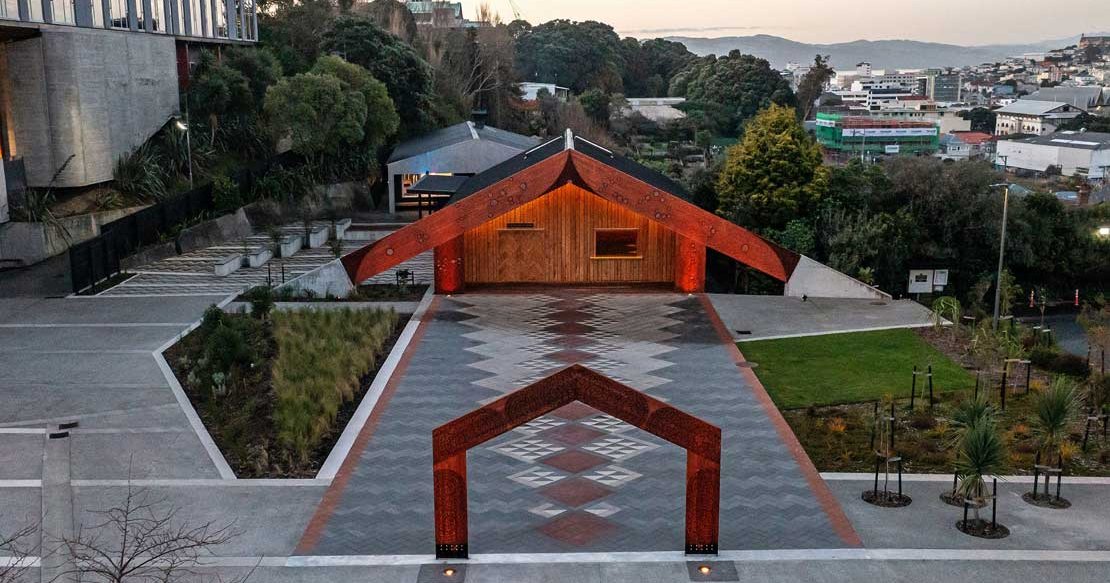
Te Rau Karamu Marae wins prestigious Purple Pin in Best Design Awards

Source:

The Te Rau Karamu Marae on the Pukeahu campus (Wellington)

Last updated: Monday 31 March 2025

Te Kāhui Toi, under the leadership of Professor Ngātai Taepa and Associate Professor Kura Puke of Toi Rauwhārangi College of Creative Arts, has been awarded a Purple Pin for the design of Te Rau Karamu Marae on the university’s Pukeahu Campus (Wellington) in the Toitanga (Māori design) category.

A Purple Pin is the highest recognition in the Best Design Awards for work that leads to advancement and programme design in Aotearoa New Zealand. The awards, delivered by the Designers Institute of New Zealand, celebrate excellence in graphic, spatial, product, digital and motion design and include three special awards – Value of Design, Public Good and Toitanga. The best entries in each category are awarded a Gold Pin and the very best project in each discipline is awarded the supreme Purple Pin.

Pro Vice-Chancellor of Toi Rauwhārangi College of the Creative Arts Professor Margaret Maile Petty says being awarded the Purple Pin in Toitanga is deep honour for the entire college.

“This is recognition of the extraordinary mahi of Māori artists working closely with mana whenua to bring this significant and beautiful taonga into being.”

The Purple Pin in Toitanga is a first for the university. Te Kāhui Toi also received two Gold Pins, one for the Toitanga category and another for Te Wairere category (lighting design). They were also awarded a Silver Pin in the Lighting Design Category.

Te Kāhui Toi is a team of artist-designers, supported by tohunga and tribal leaders, and guided by experts in their specialist knowledge. The judges acknowledged that the team’s mahi on Te Rau Karamu Marae reflects an extraordinary level of artistry, innovation and long periods of work that have gone into creation of a Marae of immense distinction. The judges’ comments were that the work was “A truly breathtaking take on what a marae can be. Flawlessly crafted with stunning detail and imagination.”

Professor Ngātai Taepa says the recognition and award is humbling.

“The calibre of the other finalists was outstanding and it is humbling to be in the company of such accomplished projects and fellow creatives. It is an honour to receive this award on behalf of Te Rau Karamu Marae, Pukeahu and Te Kunenga ki Pūrehuroa. It is an acknowledgement of tupuna wisdom, Māori creative arts, and the work of the many people involved in the creation of our marae. Nei rā te mihi o Te Kāhui Toi ki te iti, te rahi, te katoa.”

Te Rau Karamu has received longstanding guidance and support from Mana Whenua of Pukeahu Campus, Te Ātiawa, and operational support from the Office of the Deputy Vice-Chancellor Māori. 

Deputy Vice-Chancellor Māori Professor Meihana Durie says since its opening in March, Te Rau Karamu Marae continues to receive plaudits from across Te Ao Māori and Te Ao Whānui for the level of artistry and depth of mātauranga that has gone into the project.

“Te Rau Karamu represents a living, breathing expression of kaupapa and mātauranga Māori, and provides a distinctive and uniquely Māori space upon Pukeahu Campus where staff and students can thrive in the processes of ako and wānanga.

“The success of Te Kāhui Toi is also reflective of their approach to undertaking this work, working closely and collaboratively alongside many contributors including Te Ātiawa kaumātua and pakeke.  It has taken an extraordinary level of commitment to achieve this outcome and Te Rau Karamu is testament to the vison that Te Kāhui Toi have carried through their work  ”

The detailed design of Te Rau Karamu Marae

The design of the wharenui ‘Te Whaioranga o Te Whaiao’ relates to a defined area within Te Waonui (the forest) and focused on the roles of atua such as Tāne Whakapiripiri and Hinewaonui in the creation of Te Rakau Tipua – the cosmic tree. This speaks of the connections to all things, which may be experienced by all of those who enter under its canopy and into its embrace, in ceremony guided by the spatial narrative.

The description for the award reads, “In terms of the architectural partnership and relationships with engineers and fabricators, the mutual respect for kaupapa, spatial and material aesthetics resulted in shared intentions, support and drive to pursue a resolved complex that reflects the highest values of mana and manaakitanga. The majestic maihi featuring glue-lamination techniques of native totara and requiring engineering problem-solving is a testament to these relationships.”

Here is more information on the Te Rau Karamu Marae description for the Best Design Awards.

Team members who received the award include Professor Ngataiharuru Taepa, Kura Puke, Hemi Macgregor, Saffronn Te Ratana, Stuart Foster, Wi Taepa, Israel Birch, Robert Jahnke, Maihi Potaka, Te Kahui Toi whānau whānui. Contributors include Te Matahiapō, Te Huirangi Waikerepuru, Mereiwa Broughton, Inahaa Waikerepuru, Te Ngaruru Wineera, Kurt Komene, Chaz Doherty, Rangi Mataamua, Kura Moeahu, Athfield Architects.

College of Creative Arts staff and students won a total of 45 Best Awards, one Purple Pin, six Gold Pins, 16 Silver Pins and 22 Bronze Pins.
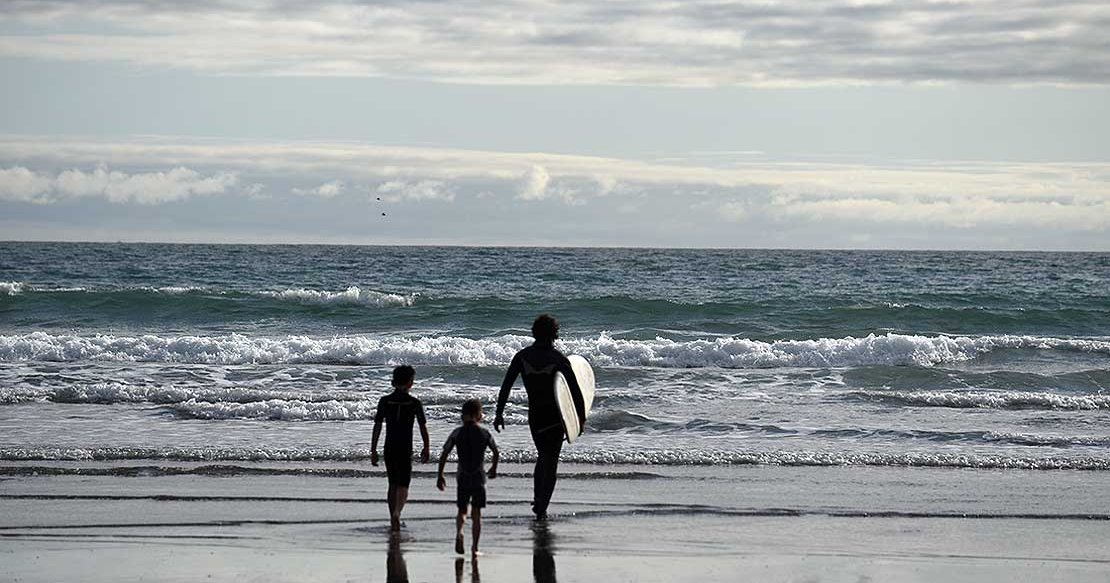
Climate change report concludes that immediate action is needed to limit inevitable impacts

Source:

The Sixth Assessment Report on Impacts, Adaptation and Vulnerability by the Intergovernmental Panel on Climate Change (IPCC) has just been released, and a Massey academic has made several key contributions.

Professor Bruce Glavovic from the School of People, Environment and Planning is co-lead author of the cross-chapter paper on Cities and Settlements by the Sea, and lead author of the chapter on Climate Resilient Development.

Professor Glavovic’s contributions conclude that rising sea levels means disruption to coastal livelihoods is inevitable, and that while we already have effective ways to prepare for these impacts and to cut emissions, there is a gap between knowledge and implementation.

“This depends on governments, civil society and the private sector making inclusive choices that prioritise risk reduction, equity and justice. International cooperation will be crucial, as will strong partnerships with traditionally marginalised groups including youth, Indigenous Peoples, local communities and ethnic minorities.”

Professor Glavovic adds that the report’s findings are particularly relevant for Aotearoa New Zealand. “Our people, the things we value, and our economies and livelihoods are concentrated along the shoreline. Resilient and sustainable coastal livelihoods depend on maintaining diverse, productive and healthy coastal ecosystems in the face of global change.”

Despite the impacts that are already being felt around the world, Professor Glavovic says there is still time to limit the damage, but action must be taken now.

“We are running out of time to avoid dangerous climate change. The IPCC is a unique and stellar example of an effective science-policy partnership. Science demonstrates that climate change is real. It is unfolding now. We need visionary political will. If political action is not taken in this decade, prospects will be dismal for us, our tamariki, and the other species we are privileged to share this planet with.”

The United Nations Secretary-General António Guterres described the IPCC report as an atlas of human suffering and a damning indictment of failed climate leadership.

The report concludes with a call to action: “The cumulative scientific evidence is unequivocal: Climate change is a threat to human well-being and planetary health. Any further delay in concerted anticipatory global action on adaptation and mitigation will miss a brief and rapidly closing window of opportunity to secure a liveable and sustainable future for all.”

Background

The IPCC report builds on an earlier IPCC report about the world’s oceans and icescapes in which Professor Glavovic was coordinating lead author on the sea-level rise chapter. Five core conditions for coastal cities and settlements to fulfil their role in climate-resilient development are identified:

  • Take a long-term perspective when making short-term decisions by keeping options open to adjust as sea-level rises and avoiding new development in high-risk locations
  • Enable more effective coordination by establishing networks across different governance levels and policy domains to build trust and legitimise decisions
  • Reduce social and climate injustice by taking historical conditions, including past emissions, and prevailing political realities into account and proactively reducing vulnerability and inequity
  • Strengthen local democracy by facilitating participation, involving stakeholders early and consistently through to implementation, with particular attention to engaging indigenous people and marginalized and vulnerable groups
  • Develop governance capabilities and tackle complex problems by drawing on multiple knowledge systems, including indigenous, local and scientific knowledge to co-design more acceptable and effective responses.

Professor Glavovic agrees, “As sentinels on the climate change frontline, coastal cities and settlements play a pivotal role in global and local efforts to adapt to unfolding climate change impacts and to navigate perilous times ahead.”

View the full report here.

EIT Auckland Valedictorian fulfils dream after long road to education

Source: Eastern Institute of Technology – Tairāwhiti

March 27, 2025

EIT Auckland valedictorian Muddassar Khot has always believed that education has no age limit.

At 42, he has now graduated with a Master of Information Technology, having balanced work, fatherhood, and student leadership along the way.

He crossed the stage as one of EIT Auckland’s two valedictorians at a graduation ceremony at the Aotea Centre on Tuesday (March 25).

“It’s a huge privilege,” he says. “I wasn’t always the top student, but I’ve always aimed high. I believe if you’re not updated, you’ll be outdated. That’s what kept me going.”

EIT Auckland Valedictorian Muddassar Khot has graduated with a Master of Information Technology.

Originally from India, Muddassar worked in Qatar in the education sector and nearly secured an IT director role in the Middle East. But when the final decision went to someone with a Western qualification, he was motivated to study abroad.

That goal took time.

“It took me five years to start the process,” he says. “Initially the plan was for my wife Shaheen to study first and then I would, however, she decided not to and then pushed me to study.”

He arrived in New Zealand in 2020 to study a Postgraduate Diploma in IT and immediately felt supported at EIT.

“During lockdown, we were isolated. But EIT acted like family. Cherie and the team organised virtual coffee mornings, moved learning online almost overnight, and made sure no one was left behind.”

He describes EIT’s culture as one of genuine care.

“The professors were incredible. They always answered my questions with a smile, even the silly ones. They never made me feel like just a student, but like a friend. That kind of support makes all the difference.”

He returned to EIT in 2023 to pursue his master’s degree—while working as Lead Networks and Systems Engineer at The IT Team.

He also juggled study with life at home, where he and Shaheen raise their three children, aged 2, 9, and 13. Their youngest was born during his studies, making the balancing act even more challenging.

“It was intense. But my wife and kids were understanding, and I couldn’t have done it without my family’s support.”

Muddassar also served as chairperson of the Student Association and helped organise trips and student support during lockdown.

“Leadership is something I value deeply. Being a leader means feeling the pain of your team and doing what you can to help.”

Looking ahead, Muddassar hopes to pursue a PhD and eventually become an entrepreneur.

He also dreams of opening a not-for-profit organisation for people with visual impairments, inspired by his grandmother and father’s struggles with sight.

“It’s my mother’s dream too,” he says. “If you can help someone, you should. Education is a treasure that never dies—and through it, we can all help build a better world.”

EIT Auckland Campus Director Cherie Freeman congratulated Muddassar.

“EIT are incredibly proud to celebrate the achievements of Muddassar who has truly exemplified determination, resilience, and a relentless pursuit of excellence throughout his journey.”

“Muddassar’s journey is a testament to the power of hard work, the support of loved ones, and the value of never giving up on one’s dreams. We wish him continued success as he embarks on the next chapter of his remarkable journey.”

Dream becomes a reality for EIT Auckland Valedictorian

Source: Eastern Institute of Technology – Tairāwhiti

March 26, 2025

When Mai Nguyễn first arrived in New Zealand in April 2023, she could only dream of one day standing on stage delivering the valedictory speech at her own graduation.

Yesterday, (March 25), she did just that — speaking as Valedictorian and graduating with a Master of Digital Business at one of two EIT Auckland ceremonies at the Aotea Centre.

“I’m so proud of it, super proud,” Mai says. “When I first started studying, I helped out at graduation ceremonies. I watched the valedictorians speak and I dreamed of being one of them. And now, it’s come true.”

EIT Auckland Valedictorian Mai Nguyễn has graduated with a Master of Digital Business.

Originally from Vietnam, Mai holds a Bachelor in Hospitality Management and had a successful career in marketing at a cybersecurity company before moving abroad with her husband Tran Khanh Hiep and their then two-and-a-half-year-old son Tran Khanh An. Despite the challenges of starting over in a new country, Mai embraced every opportunity with determination and heart.

She completed her Master of Digital Business at EIT Auckland and quickly became a valued part of the student community, serving as a student representative and mentor.

That sense of support is something she felt from the moment she enrolled. “The EIT philosophy of providing the support to succeed is true. From day one, I felt it. Even when I lost my first assignment due to a technical issue, and the librarian from Napier helped me late at night. That meant so much.”

She describes the Auckland campus as small but warm — a place where “everyone knows your name” and where international students are truly looked after.

“I always felt like I belonged. There’s something special about how EIT supports students. They see more than just your grades; they see your heart and your effort.”

EIT Auckland Valedictorian Mai Nguyễn pictured with her husband Tran Khanh Hiep and their then two-and-a-half-year-old son Tran Khanh An on their way to New Zealand.

Now working as a business development manager for an immigration company, Mai helps other migrants find their path in Aotearoa. She hopes to become a licensed immigration advisor and continue supporting Vietnamese students who want to study in New Zealand — including, she hopes, at EIT.

“I still tell EIT staff, if you ever need my help, I’ll be there,” she says. “I believe in what EIT offers — not just education, but care.”

“I wasn’t always this helpful or reflective,” she adds. “Back in Vietnam, I was career focused. But studying here helped me grow. I realised that success isn’t just about what you achieve — it’s about the impact you have on others.”

To new international students, Mai offers heartfelt advice.

“Change is not scary, it’s part of growth. You might suffer and struggle, but everything will be fine in the end. Do good, and good will always come back to you.”

EIT Auckland Campus Director Cherie Freeman says this achievement is a testament to Mai’s dedication, hard work, and commitment to excellence throughout her studies.

“The team at EIT is incredibly proud of all that Mai has accomplished. We are also deeply grateful for the unwavering support she has shown to the student community. Time and time again, Mai stepped up to help—whether by helping, providing guidance, or simply being there when needed. Her willingness to lend a hand, often on short notice, and her consistent presence on campus, sometimes on a daily basis, have made a significant impact.

“Mai has truly earned this distinction, and EIT wishes her all the best in her future endeavours. She will always have a special place in the EIT family.”

Milestone moment as EIT Auckland celebrates largest ever graduation

Source: Eastern Institute of Technology – Tairāwhiti

March 25, 2025

Celebrations filled the Aotea Centre as the EIT Auckland Campus held its largest ever graduation, with a record 216 students crossing the stage in front of proud family, friends and faculty.

To accommodate the growing number of graduates, two ceremonies were held – 96 students in the morning and 120 in the afternoon. The graduates, many of whom are international students, received postgraduate degrees and diplomas across a variety of disciplines at the ceremonies today (March 25).

The EIT Auckland Campus held its graduation ceremonies today.

EIT Auckland Campus Director Cherie Freeman congratulated the graduates and acknowledged the commitment and perseverance they had shown throughout their studies.

“This is a momentous occasion for our campus,” she said. “Not only is it our largest graduation to date, but it’s also a celebration of the incredible resilience, hard work and cultural diversity our students bring to EIT Auckland.”

Among those honoured were valedictorians Muddassar Khot, who graduated with a Master of Information Technology, and Mai Nguyễn, who graduated with a Master of Business. Both delivered heartfelt speeches reflecting on their academic journeys and the support of their peers, tutors and families.

EIT Auckland offers a selection of programmes in business, computing and health science, including the Master of Applied Management, Master of Digital Business, Master of Logistics and Supply Chain Management, Master of Information Technology, and Master of Health Science.

“Graduation is a special occasion not just for our students, but for everyone who has supported them along the way,” said Cherie. “We’re excited to see the impact our graduates will go on to make in their communities and industries.”

Tairāwhiti Graduates Celebrate Success

Source: Eastern Institute of Technology – Tairāwhiti

  • Home
  • News
  • Tairāwhiti Graduates Celebrate Success

March 24, 2025

Forty-four graduates from EIT Tairāwhiti proudly crossed the stage at the War Memorial Theatre in Gisborne, marking the culmination of years of dedication and perseverance.

The ceremony, held on Friday, was a moment of celebration not only for the graduates but also for their families, friends, and tutors who supported them through their educational journeys. In total, EIT awarded 407 qualifications to Tairāwhiti-based learners who completed their studies last year.

Among the highlights of the event was the Valedictorian’s address delivered by Bachelor of Teaching (Primary) graduate Heather Glover. Barry Soutar was guest speaker and Gisborne Mayor Rehette Stoltz attended.

EIT Interim Operations Lead Glen Harkness acknowledged the graduates’ efforts and the dedication they put into their studies.

“Graduation is a special milestone, and it’s great to see our graduates celebrating their achievements. They’ve put in the effort and should feel proud of what they have accomplished,” he said. “Their time at EIT has equipped them with valuable skills and knowledge, setting them up for success in their future endeavours. We wish them well as they take their next steps.

Glen also acknowledged the support of tutors and the wider EIT community in preparing graduates for the workforce.

The Tairāwhiti graduation was the first in a series of EIT ceremonies. The Auckland graduation is scheduled for Tuesday, March 25, followed by the Hawke’s Bay graduation on April 11.

Celebrations as EIT Hawke’s Bay students graduate

Source: Eastern Institute of Technology – Tairāwhiti

April 12, 2025

There was a strong sense of celebration in Napier today as 300 EIT students marked the end of their study journey.

Two ceremonies were held at the Napier Municipal Theatre on Friday (April 11), with whānau, friends and supporters gathering to mark the occasion. In total, EIT awarded 2,241 diplomas, degrees and postgraduate qualifications to Hawke’s Bay-based learners who finished their studies last year.

The morning ceremony recognised graduates from the Centre for Veterinary Nursing, IDEAschool, Te Ūranga Waka, and the Schools of Education and Social Sciences, Primary Industries, Tourism and Hospitality, Trades and Technology, and Viticulture and Wine Science.

A graduation parade through Napier’s city centre followed, with students, staff, and supporters cheered on by the community.

In the afternoon, students from the Schools of Business, Computing, Health and Sport Science, and Nursing were celebrated.

Valedictorians Elijah Rogers and Kayla Hughes delivered heartfelt speeches reflecting on their time at EIT. Olympian Nigel Avery was the special guest speaker, and Tukituki MP Catherine Wedd was also in attendance.

EIT Interim Operations Lead Glen Harkness congratulated all those who graduated.

“It’s always a proud moment to see our students cross the stage. Graduation is the result of hard work, focus, and a real commitment to learning. Each of our graduates can feel proud of what they’ve achieved.”

He also acknowledged the role of EIT staff.

“Our lecturers and tutors are passionate about supporting student success. These ceremonies are a reflection of their dedication and the high-quality programmes we continue to offer across the board. We have no doubt that these graduates’ futures look bright.”

Graduation ceremonies were also held in March for EIT’s Tairāwhiti and Auckland students.

Education Should be Led by Experts-Not Economists

Source:

Te Pāti Māori are appalled by Cabinet’s decision to agree to 15 recommendations to the Early Childhood Education (ECE) sector following the regulatory review by the Ministry of Regulation. We emphasise the need to prioritise tamariki Māori in Early Childhood Education, conducted by education experts- not economists.

“Our mokopuna deserve an education system shaped by their needs – and that must be led by the total immersion Māori education sector,” said Te Pāti Māori spokesperson for education, Tākuta Ferris.

“Research shows that a strong sense of identity is central to the success of tamariki Māori. Instead of defunding key programmes and continuing to allocate just 1% of total education funding to Māori education, the government should be investing in the Māori educational systems that are already delivering for our tamariki.

“A government that develops education policy within David Seymour’s cost-cutting Ministry, shows a clear disregard for the future of our tamariki Māori.”

“There is no table fit to make decisions about the education of mokopuna Māori without Kōhanga Reo and Te Rūnanga Nui o Ngā Kura Kaupapa Māori at it,” says Hana-Rawhiti Maipi-Clarke, Te Pāti Māori spokesperson for total immersion education.

“They are more equipped than any government body to know what our tamariki need – not just in the classroom, but for their future.

“The government must be held to account for its commitment to the recommendations made in Wai 2336. That means creating standalone legislation with policies specifically designed to support Māori education and to give whānau real, meaningful choices,” concluded Maipi-Clarke.

Te Pāti Māori remains resolute in protecting the mana and mauri of Kōhanga Reo by ensuring all policies and regulations uphold and advance its kaupapa as a taonga tuku iho for our babies and mokopuna.

Release: Simeon Brown hid Dunedin Hospital downgrade

Source:

Simeon Brown needs to come clean to the people of Dunedin about why he hid plans to downgrade their new hospital’s Intensive Care Unit.

The Otago Daily Times today revealed then-Health Minister Dr Shane Reti was told on January 23 this year that the number of ICU beds would be reduced on opening from 30 to 20.

“Simeon Brown then took over as Health Minister and swooped into Dunedin a week later trying to act the hero on the hospital. But he failed to share this important information about downgrading the number of ICU beds,” Labour acting health spokesperson Peeni Henare said.

“While attempting to patch up the mess National had made of Dunedin Hospital he hid the fact a third of its planned intensive care beds had been cut.

“That is hugely disingenuous. I can see why locals, including the former head of the emergency department, are angry,” Peeni Henare said.

This follows reporting by Stuff at the weekend that New Zealand is nationally 500 hospital beds short.

“Simeon Brown continues to claim everything is going to be okay despite announcing a health infrastructure plan without a cent of actual funding attached, and stopping hospitals from hiring the workforce they need under the guise of saving money,” Peeni Henare said.

“National’s track record is to scale back and delay hospital builds as it has done with Nelson and Dunedin hospitals, which will cost New Zealanders more in the long run. Simeon Brown is content kicking the can down the road while people’s health suffers,” Peeni Henare said.


Stay in the loop by signing up to our mailing list and following us on FacebookInstagram, and X.

Release: Food prices further stretching the family budget

Source:

Families already stretched by rising costs will struggle with the news food prices are going up again.

“The weekly shop is a challenge for many families right now, and the rising price of staples like butter and mince won’t help,” Labour finance and economy spokesperson Barbara Edmonds said.

The latest figures from Stats NZ show food prices rose 3.5 percent over the past year, with butter up a staggering 64 percent, milk up 16 percent and meat up more than five percent.

“The Government’s only answer to rising costs has been tax cuts. They cost billions and have disappeared into rising weekly bills for New Zealanders,” Barbara Edmonds said.

“They chose not to lift the minimum wage in line with inflation, taking those on the lowest wages in our country backwards. Rates and insurance have both increased for those who own their home.

“Nicola Willis also won’t commit to not cutting the Best Start or Winter Energy Payments. These are vital safety nets which help new parents pay the bills and our most vulnerable heat their homes in winter.

“Groceries are one of the biggest weekly costs for households, and right now, Kiwis are not getting the support they need to keep up,” Barbara Edmonds said.


Stay in the loop by signing up to our mailing list and following us on FacebookInstagram, and X.