Budget to increase energy hardship

Source: Green Party

Budget 2025 delays our transition to a low emissions and low-cost energy network, this will put even more pressure on households, businesses and the climate. 

“This Budget doesn’t leave enough to keep the lights on, let alone spark the transition towards a low-emissions and low-cost electricity network,” says the Green Party’s Spokesperson for Energy, Scott Willis.

“Stripping $56 million from the Energy Efficiency and Conservation Authority comes on top of last year’s vicious cut. This cut is effectively delivering energy hardship to those who are already struggling.

“Aotearoa can be a country where every home is powered with clean, green affordable energy that lowers our emissions and lowers costs on households. However, this will require action and ambition, something that is completely missing in this Budget. 

“A meagre $2 million for households to counter energy hardship is a joke when we know there’s some 110,000 households doing it tough.

“Since the Government has come into power we have seen the preservation of an energy market that prioritises profit and fossil fuels over our communities and the climate. This Budget further cements that direction and opens the door wide open to more fossil fuelled climate disasters. 

“A Green Government would separate the gentailers that are dominating the energy market and invest $4.8 billion in renewables over four years directly in new renewable energy and storage to benefit both people and planet in the long and short term. We can have cleaner, cheaper, smarter power with the right political will.  

“Through a mix of grants and interest-free loans, our Green Budget would create a Clean Power Payment to help people cover the upfront cost of zero carbon upgrades and energy efficiency.

“It’s not inevitable that thousands of people have to choose between heating and eating. Our energy network needs to work for us, instead of serving shareholders. 

“We can build a more sustainable and affordable energy network that puts people and planet before the profits of our gentailers,” says Scott Willis.

Budget 2025 a betrayal of working people – E tū

Source:

E tū, Aotearoa’s largest private sector union, is condemning Budget 2025 as a direct attack on working people, particularly women in frontline care and community services.

The Government has slashed nearly $13 billion that would have gone to pay equity claims, gutting the mechanism that ensures fair pay for women in undervalued, female-dominated sectors like care and support. These cuts will pay for their Budget which includes tax breaks for businesses.

“This Budget is a theft of wages from women,” says E tū National Secretary Rachel Mackintosh.

“The Government is paying for its corporate handouts by stealing from the pockets of caregivers, teacher aides, and social workers. It’s a cynical, calculated betrayal.”

The pay equity changes, rushed through under urgency, have extinguished 33 active claims and raised the bar so high that future claims may be impossible.

“The Government has made it clear: if you’re a woman in a caring profession, they don’t care about you.”

The Budget also halves the Government’s contribution to KiwiSaver, dropping the maximum from $521 to just $260.72 per year.

“This is a short-sighted move that undermines the retirement security of working people. It’s a massive barrier to building a future where everyone can retire with dignity.”

Public broadcasting has also been targeted, with RNZ facing an $18 million cut over four years.

“At a time when misinformation is rampant, gutting our public broadcaster is a dangerous step backwards. It looks like the Government is afraid of real scrutiny from the fourth estate.”

Other cuts include the full means-testing of the Best Start child payment, tighter welfare rules for young people, and the removal of pay equity funding for community and iwi providers.

“This Budget punishes the people who hold our communities together. It’s not about fiscal responsibility, it’s about ideological cruelty.”

E tū is calling on the Government to reverse these cuts and engage in genuine dialogue with workers, unions, and communities.

“We will not stand by while the Government dismantles the foundations of fairness in Aotearoa. This fight is far from over.”

Seventy-four new constables heading to districts in a week

Source: New Zealand Police

Commissioner Richard Chambers, members of the police executive and wing patron former police assistant commissioner, Allan Boreham congratulated 74 graduating constables from Wing 384 today. 

Also attending the graduation and presenting a prize in absence of the Minister of Police was her worship Anita Baker, the Mayor of Porirua.

Families and friends celebrated the newly attested police officers at Te Rauparaha Arena, Porirua this afternoon to acknowledge the successful completion of their initial training course. 

There are some likeminded individuals in the wing with 11 of the graduates having family members currently working in police.

Four graduating officers made the change from non-constabulary roles to police officers.

The wing is very diverse with eighteen recruits speaking more than one language and 19 recruits who were born overseas. The top prize winner was born and raised in France.

Top of wing, Constable Diane Aspalvo is a French-trained and certified clinical psychologist. She has worked as a psychologist in Paris and in Tairawhiti New Zealand before deciding to join the New Zealand Police.

She previously volunteered for the French Army as a reserve after a call-up for national security due to the terrorist attacks in France in 2015. She is a keen swimmer, skier and is also into CrossFit.

“I decided to join the New Zealand Police at 41 years old, so I am a living proof that it is never too late to achieve your dreams.”

Diane will be deployed to Eastern District.

Second Top Award winner Constable Hunta Sutherland, Ngāti Kuia is also a sporting talent, representing her district, Tasman, in football up to high school level.

Not only is she a ‘Golden Boot’ winner for the most goals scored  in a regional competition (39), she’s into running track, cross country, and road races with many podium finishes. Hunta has worked as a teacher’s aide with troubled and autistic youth which she found inspiring.

“While training at college I found strength I never knew I had, and a purpose I’ll never forget.”

Hunta will be based in Tasman District.

Leadership Award winner Constable Charise Perez is also a keen sports person excelling in netball. She was born in Wellington and raised by her Fijian dad and Samoan mother. Charise has experience in hospitality, service and politics. 

She began her employment at the Electoral Commission as an administrator. She was a community liaison and worked on the 2020 elections and has also managed administration for an emergency housing organization called Tuatahi Centre. 

As the leadership award winner, Charise gave a speech to the wing.

“I stand here today as a product of the relationships and bonds between the members of wing 384. Together we began our journey as strangers, but today we stand as brothers and sisters.

As we take the next step in our police journey, I believe that each and every one of wing 384 are more than capable of fulfilling the oath that we have just taken.”

Charise, a former Authorised Officer for Police, will be based back in Wellington District to start policing.

The wing is dispersed as follows:

Deployment:

Northland 3, Tāmaki Makaurau a total of 23 and broken down as follows: Waitematā – 9, Counties Manukau – 14, Waikato – 4, Bay of Plenty – 8, Eastern – 3, Central – 8, Wellington – 9, Tasman – 6, Canterbury – 3, Southern – 7.
The new constables will start their first week of duty in their Police districts from Monday 2 June 2025 and will continue their training on the job as probationary constables.

Awards:

Minister’s Award recognising top student: Constable Diane Aspavlo, posted to Eastern District. 
Commissioner’s Award for Leadership: Constable Charise Perez, posted to Wellington District.
Patron’s Award for second in wing recognising second top student: Constable Hunta Sutherland, posted to Tasman District.
Driver Training and Road Policing Practice Award: Constable Ethan Baldwin posted to Waitematā District.

Demographics:

25.7 percent are female, 74.3 percent are male. New Zealand European make up 56.8 percent of the wing, with Māori 12.2 percent, Pasifika 17.6 percent, Asian 10.8 percent, LAAM 2.7 percent. 

383 Wing Patron: Allan Boreham:

Allan Boreham is a retired Assistant Commissioner of Police and former head of Youth Justice for Oranga Tamariki, Ministry for Children. Allan holds the New Zealand Police in very high esteem and is honoured to be the patron for Wing 384.

He says he is looking forward to supporting the wing members to succeed and gain all the satisfaction a Police career offers. Allan joined Police in 1985 (in Wing 97) and served for more than 33 years. He was also a Deputy Chief Executive in the public service for five years in charge of Youth Justice.

His Police career was varied and involved completing a wide range of roles in public safety, investigations, and road policing. These included postings in Auckland, Tokoroa, Hamilton and Wellington.

He received an award for his leadership in solving the 1997 kidnapping and murder of an Auckland businessman, Graham Kirkwood.

Allan holds a Bachelor Arts, majoring in Sociology, from Massey University. He is currently learning to speak Spanish and is also a keen motorcyclist and skier.

His father Bruce, now in his eighties, also served in the Police for 32 years.

ENDS

Watch out for our Ten One story coming soon with more images and stories.

If you’re interested in joining police check out newcops.govt.nz

Issued by Police Media Centre

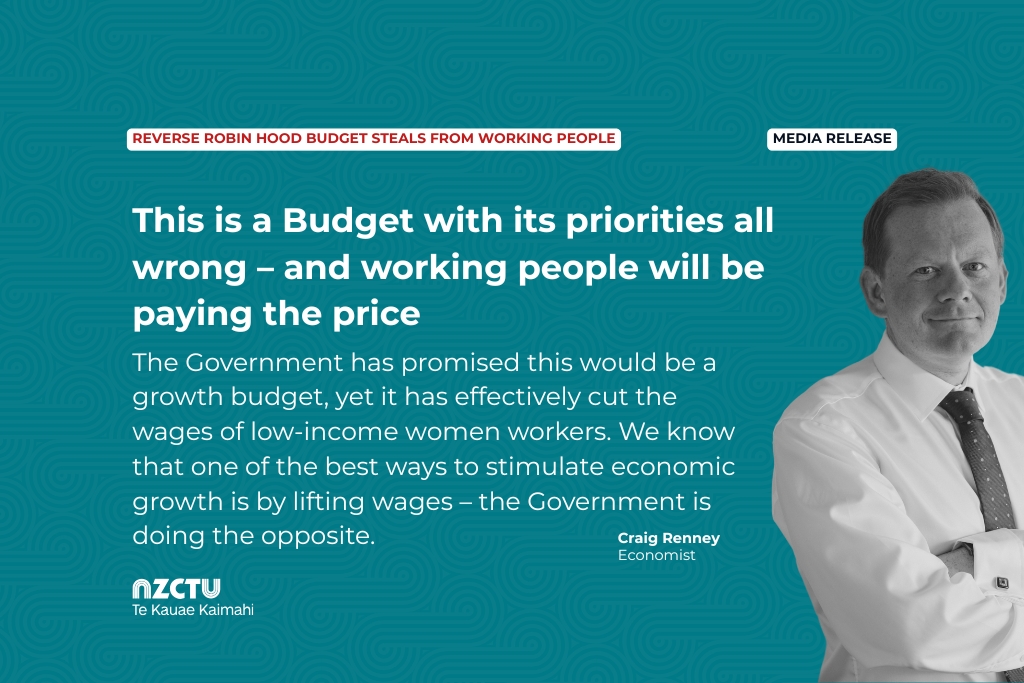
Reverse Robin Hood Budget steals from working people

Source: Team effort to rescue teens

Budget 2025 takes $12.8bn from low-income, female dominated workforces to prop up the Government’s failed economic policies, said NZCTU Te Kauae Kaimahi Economist Craig Renney.

“The Government has promised this would be a growth budget, yet it has effectively cut the wages of low-income women workers. We know that one of the best ways to stimulate economic growth is by lifting wages – the Government is doing the opposite,” said Renney.

“The figures released today also showed that the number of people on Jobseekers Support is rising, and higher than forecast just last year. Real wage growth is lower than forecast last year – the Treasury itself says the Budget “lowers wage growth”. This is a Budget that is taking working people backwards.

“The Budget delivers more cuts to investment, including real terms cuts to early childhood education funding. New funding for learning support is largely being delivered by cutting funding from other programmes in education. Māori Development programmes have been cut significantly, as has funding from our media, culture, and heritage institutions.

“Promises made in health aren’t provided with new funding and the destruction of the pay equity process will mean we will continue to lose health workers to Australia, putting further stress on the system.

“Forecasts show we will continue to miss our child poverty targets over the next four years, and we will see thousands of families loose essential income due to cuts to Best Start and Working for Families. The Government is taking money from unemployed 18- and 19-year-olds, while investing nothing in action on climate change.

“Overall, this is a Budget that works by taking away from some of the poorest people in New Zealand, to fund tax cuts for multinationals, increased investment in corrections, the failed charter schools project, and more spending on defence.

“This is a Budget with its priorities all wrong – and working people will be paying the price,” said Renney. 

Name release: Fatal crash, Takapau

Source: New Zealand Police

Police can now release the name of the person who died in the two-vehicle crash on State Highway 2 near Takapau, on Tuesday 13 May.

He was Tony Paul Saunders, 55, of Norsewood.

Police extend their sympathies to his family and friends at this difficult time.

The circumstances of the crash remain under investigation.

ENDS

Budget 2025

Source:

Last updated 22 May 2025

Print

Share

The Government’s Budget includes initiatives for the tertiary sector that provide targeted increases to tuition and training subsidies and fund a forecast increase in enrolments for 2025 and 2026. Other initiatives support the transition to the redesigned vocational education and training (VET) system and reprioritise funding within Vote Tertiary Education.

Key highlights

$111.4 million for enrolment increases in 2025 and 2026
3% tuition subsidy increase for targeted priority provision at Levels 1–10 on the New Zealand Qualifications and Credentials Framework (NZQCF) from 1 January 2026
1.75% tuition subsidy increase for targeted priority provision at Levels 7–10 on the NZQCF from 1 January 2026
Funding for the Student Loan Scheme to enable providers to increase fees by up to 6% in 2026
Funding to support the continuity of standards-setting functions during the transition from Workforce Development Councils (WDCs) to the new Industry Skills Boards (ISBs)
Reprioritisation of funding within Vote Tertiary Education  

Summary of announcements for tertiary education
Budget 2025 provides $111.4 million in additional funding over the next four years to support growing the domestic pipeline of students. This funding will enable the Tertiary Education Commission (TEC) to fund 99% of forecast tertiary education and training enrolments in 2025 and 2026. It also funds approximately 175 additional Youth Guarantee equivalent full-time students (EFTS) per year.
The Government has announced two initiatives designed to help providers manage cost pressures and maintain the quality of their delivery in targeted fields, and further invest in priority areas.
The first initiative provides $212.5 million of operating funding over the next four years to increase tuition and training subsidies by 3% from 1 January 2026, for targeted priority provision at Levels 1–10 on the NZQCF and other foundation education. Targeted areas include:

All foundation education funds, excluding the Māori and Pacific Trades Training Fund (MPTT)
Areas aligned with trades, agriculture, engineering and health sciences at Levels 3–7
At Levels 7–10 (degree):

Science and clinical psychology  
Medical imaging
Medical laboratory science
Optometry
Medical radiation therapy
Veterinary science
Medical undergraduate
Mathematics
Nursing degree
Agriculture and horticulture
Priority engineering
Initial teacher education. 

A second initiative provides an additional $64.4 million in funding over the next four years to increase tuition and training subsidies by 1.75% from 1 January 2026 for targeted priority provision at Levels 7–10 (degree and above) on the NZQCF. This follows the end of the time-limited 4% increase to tuition subsidies introduced in 2023. Priority areas targeted by the Government are:

Science and clinical psychology  
Medical imaging
Medical laboratory science
Optometry
Medical radiation therapy
Veterinary science
Medical undergraduate
Mathematics
Agriculture and horticulture
Priority engineering
Initial teacher education 

A further initiative funds forecast costs to the Student Loans Scheme from increasing fees by up to 6% in 2026. In June this year, the Minister for Universities will consult on the proposed Annual Maximum Fee Movement (AMFM) rate of 6% in 2026 through a public consultation notice published in the New Zealand Gazette.
To support the continuity of standards-setting functions during the transition to the redesigned vocational education and training system, Budget 2025 provides up to $15 million for WDCs to ensure that they can continue to perform their statutory functions until their disestablishment on 31 December 2025.
From 1 January 2026, Industry Skills Boards (ISBs) will receive $30 million per annum in dedicated funding, reprioritised from within Vote Tertiary Education, to support delivery of standards-setting and their other legislated functions. Budget 2025 provides a one-off $10 million in funding for 2025/26 to assist with transition costs, including the establishment of ISBs.
Funding of up to $10 million per annum to support strategically important vocational education and training (VET) provision will be available for institutes of technology and polytechnics during the transition from Te Pūkenga to the new VET system. This is a transitional fund and will be available for two years, over 2026 and 2027.
In line with the Government’s priority to deliver effective and fiscally sustainable public services and the need to focus on core activities in the current constrained fiscal environment, some funding has been reprioritised towards other areas of tertiary education.
Further information
For Budget announcements, see Latest from the Beehive – Beehive.govt.nz.
For information on 2026 funding rates, see Funding rates by year. 

Government pours gas on the climate crisis fire

Source: Green Party

Budget 2025 has put our climate targets in serious jeopardy, says the Green Party. 

“Today the Government has done even worse than deny or delay climate action – they’ve actively chosen to pour gas on the fire,” says Green Party Co-Leader and spokesperson for Climate, Chlöe Swarbrick. 

“The Government is setting $200 million of our public money on fire to support fossil fuel executives’ profit, handing a lifeline to a sunset industry, instead of investing in real, resilient, renewable energy.

“They have the gall to call themselves ‘responsible economic managers’ while leaving us vulnerable to paying out billions in climate liabilities for failing to meet the Paris Agreement, which they also consistently act to push further out of reach.

“Our communities are confronted with ‘one in one hundred year’ climate change charged weather events year on year. The climate crisis is here. The measure of how much worse things get is the Government’s willingness to act.

“Christopher Luxon knows all of this and has said, ‘yeah, nah’ to a liveable future for all. New Zealanders need to know that this is not inevitable.

“The Greens have shown how we can reduce climate-changing emissions five times faster than the Government’s plan, while reducing the cost of living, and improving the quality of life.

“Time and again, this Government shows us whose side they’re on, and it’s not that of regular people, future generations or the planet we all share,” says Chlöe Swarbrick.

Budget 2025 leaves future of school lunches uncertain

Source: Green Party

The future of the Ka Ora | Ka Ako school lunch programme looks to be uncertain with Budget 2025 failing to provide any funding beyond 2026. 

“The Government’s refusal to commit to funding the school lunch programme leaves thousands of families unsure whether their kids will be fed or forgotten,” says the Green Party’s spokesperson for Education, Lawrence Xu-Nan.

“Our children deserve better. They deserve kai that nourishes them, setting them up to achieve their full potential. The Government could have used today’s Budget to commit to feeding our kids good food, instead, it has left our most vulnerable tamariki wondering whether they will have lunch at school past next year. 

“The writing has been on the wall for months. ‘Seymour’s slop’ was always funded to fail. All of this looks to be a prelude to the programme being cut completely. 

“Expecting children to focus and succeed in school with empty stomachs is not just unrealistic, it’s inhumane. 

“Failing to fund this programme beyond next year shows exactly where this Government’s priorities lie–and it’s not with our children’s wellbeing. 

“As the Green Party showed last week, this is not inevitable. Our plan lays out real solutions, including expanding free school lunches, as a baseline funding, to more than 150,000 additional children every day. 

“We want all tamariki in Aotearoa to thrive and have a sense of belonging in schools.

“That means no child should go to school hungry. Full stop, end of story,” says Lawrence Xu-Nan.

Have you seen Marilyn?

Source: New Zealand Police

Police are asking for the public’s help finding Marilyn, who has been reported missing from the Ponsonby area.

The 14-year-old was last seen on 18 May and is described as about 175cms tall with brown eyes and brown hair.

Police and Marilyn’s family have concerns for her welfare and would like to find her as soon as possible.

If you have seen her or have information that might help us find her, please call 111 and quote reference number 250519/9845.

ENDS.

Holly McKay/NZ Police

Largest boost to Learning Support in a generation

Source: NZ Music Month takes to the streets

Largest boost to Learning Support in a generation
The Government is delivering the most significant investment in learning support in a generation to better support Kiwi kids to thrive at school, Education Minister Erica Stanford says. 
Key investments include substantial annual increases to teacher aide hours, building up to over 2 million additional teacher aide hours per year, from 2028; Learning Support Co-ordinators for all schools with Year 1-8 students; expanding early intervention services from early learning through to end of year 1; and an historic overhaul of the Ongoing Resourcing Scheme (ORS) funding model to ensure that demand for the service is met with guaranteed funding so all students with high and complex needs who are verified for ORS receive the support they need.
“Too many children wait too long to receive support, or miss out altogether, on the help they need to succeed. We are addressing this by investing in a smart, system-wide reform that significantly increases specialist and support staff resources in our schools. 
“We’re powering up support to the frontline and investing early to ensure our kids get the tailored help they need, and so that teachers have more time to teach the basics brilliantly,” Ms Stanford says.
Budget 2025 invests $2.5 billion over the forecast period in Vote Education with a focus on delivering a transformational boost to learning support funding.
“Backed by a social investment lens, this is a seismic l shift in how we support learning needs in New Zealand. We’re deliberately prioritising early intervention, investing in what works and directly tackling long-standing inequities in the system.”
The learning support funding package includes:

$266 million to extend the Early Intervention Service (EIS) from early childhood education through to the end of year 1 of primary school. This will fund more than 560 additional FTE for EIS teachers and specialists. We are investing in:

expanding the service through to the end of Year 1 to support the effective transition into school of around 4,000 children with additional needs.
reducing existing waitlists in early intervention so that more than 3,000 children that need the support receive it sooner.
increasing the amount of specialist support provided to the more than 7,100 children who are currently enrolled in EIS.
building up annually to an additional 900,000 teacher aide hours per year, from 2028, to support young learners in EIS.

$122 million to meet increased demand for ORS (Ongoing Resourcing Scheme) for students with high and complex needs. This includes a structural change to the funding model so every child who is verified for ORS funding receives the support they need. This investment will also increase the number of specialists and teacher aide time to support the more than 1,700 additional learners forecast to access ORS over the next four years.
$192 million to ensure that over three years, all Year 1-8 schools and kura are funded for a Learning Support Coordinator to work with students, families and educators to identify and respond to learner needs. This investment will benefit 1250 schools and an additional 300,000 learners around New Zealand.
$43 million for an extra 78.5 FTE speech language therapists, as well as additional psychologists and supporting teacher aide hours to help meet the growing demand of students with communication and behaviour needs. This will provide specialist supports to around 2500 students over the next four years.
$3 million of investment in our teacher aides with targeted professional development for working with learners with social, emotional, wellbeing, behavioural, and neurodiverse needs.
$4 million to employ 25 intern educational psychologists each year to enable a more sustainable pipeline of locally trained workforce.
$90 million of capital for approximately 25 new learning support satellite classrooms to provide around 225 new student places across the Ministry of Education’s specialist school network, as well as provide learning support property modifications so that schools are more accessible to learners with additional needs.  

“Across all learning support services in Vote Education, we are building up to more than 2 million additional teacher aide hours into the system every year from 2028. 
“The education sector has been calling for more support for a long time, and this Government is delivering results. This investment recognises and responds to the growing number of children with additional learning needs and the pressure it places on teachers,” Ms Stanford says. 
Budget 2025 also includes substantive key investments in the Government’s priority areas:

$298 million into strengthening Curriculum and Assessment supports, including $132.2 million for accelerated learning in literacy and maths.
$572 million of capital funding invested into school property.
$100 million of operating funding, to maintain and upgrade classrooms.
$150 million to build the education workforce of the future through leadership development pathways, teacher supply initiatives, and funded registration and certification.
$104 million to support Māori learner success, including $50 million of capital funding for new classrooms in Māori Medium and Kaupapa Māori schools.
$140 million for a new attendance service and to support and strengthen frontline attendance services

 
“To deliver this investment, we have assessed underspends and reprioritised initiatives that are underperforming or lack clear evidence that they’re delivering intended outcomes. Around $614 million within the vote has been identified for reinvestment into frontline, priority education initiatives.
“Budget 2025 builds on the strong foundations we’ve already laid through teaching the basics brilliantly. We will continue to invest to raise achievement and close the equity gap in schools across the country, so all Kiwi kids have the knowledge, skills and competencies they need to reach their full potential,” Ms Stanford says.