Celebrating Predator Free 2050 progress from Waiheke to Akaroa

Source: NZ Department of Conservation

New Zealand’s Predator Free 2050 movement is stronger than ever with 9000+ community trapping initiatives and 20 large landscape projects. In this blog, we look at five stories from communities across the country that show the growing momentum behind Predator Free 2050.

Possums are being eradicated from Tekimoka/Mt Te Kinga on the West Coast. It’s surrounded by farmland, so collaboration with farmers has been vital to success so far. Photo supplied by Predator Free Te Kinga.

DOC is the lead agency for PF2050 working in collaboration with iwi and hapū, NGOs, businesses, central and local government, scientists and communities. Tens of thousands of people are taking action for nature by trapping in backyards, joining predator-free groups and donating resources.

Our collective effort to eradicate rats, stoats and possums is making a huge difference. Together, we are providing greater protection for native species across millions of hectares of land, researching and innovating new tools and technologies, empowering more people and communities to get involved, and unlock ways to eradicate predators in new areas.

Predator Free Waiheke – guarding the mouth of the Waitematā

Since stoat eradication began on Waiheke Island five years ago, native bird numbers have increased by 76%. The work has proved particularly beneficial for stoat sensitive birds, such as kākā, which are up 388%, and kiwi, which were safely returned to the island earlier this year.

This success is a testament to the group’s perseverance and innovation. With a network of 1,700 traps checked every fortnight, volunteers have managed to catch 258 stoats on Waiheke.

Along the way, the locals have come up with some ingenious ideas. Their inventions include a portable ‘interceptor’ mesh fence designed to funnel stoats (or other mustelids) into a trap by blocking or limiting their preferred escape or travel pathways. There’s also a new trap in the mix, the ‘Salisbury saucer, which is a multi-entry trap system designed to blend into the environment. It’s Kiwi ingenuity at its finest!

There are already 17 predator free islands in the Hauraki Gulf, and they are bustling with wildlife. Waiheke is exceptional because it’s visited by nearly a million people every year. This presents a biosecurity challenge to stop predators from returning to the island on boats. If this can be managed, the island could eventually support large populations of rare native species, and the wider Auckland region would see more birds in backyards and reserves. 

The portable ‘interceptor’ fence designed by a Waiheke local to funnel evasive stoats towards traps. Photo supplied by Predator Free Waiheke.

Predator Free Dunedin – people power

There are more than 1000 people trapping across Dunedin’s urban and rural areas. These volunteers are united through a collective of 22 organisations working together to protect native species, strengthen communities and share predator free expertise across the country.

On the ground, this coordinated effort is transforming the region. The Otago Peninsula is nearly free of possums which is enabling the forest to quickly regenerate. Native bird populations are increasing, and it’s becoming more common to see tūī, kererū, bellbird/korimako, kākā and rifleman/titipounamu in the region.

Predator Free Dunedin has played an important role in trialling new technology to target predators, such as scat detection dogs, drone technology with thermal imaging to survey harder-to-reach areas, and traps using AI to target specific predators.

Since 2018, hardworking people across Dunedin have removed more than 60,000 possums, 20,000 rats and 2,000 mustelids. The Predator Free 2050 movement is strong down south!
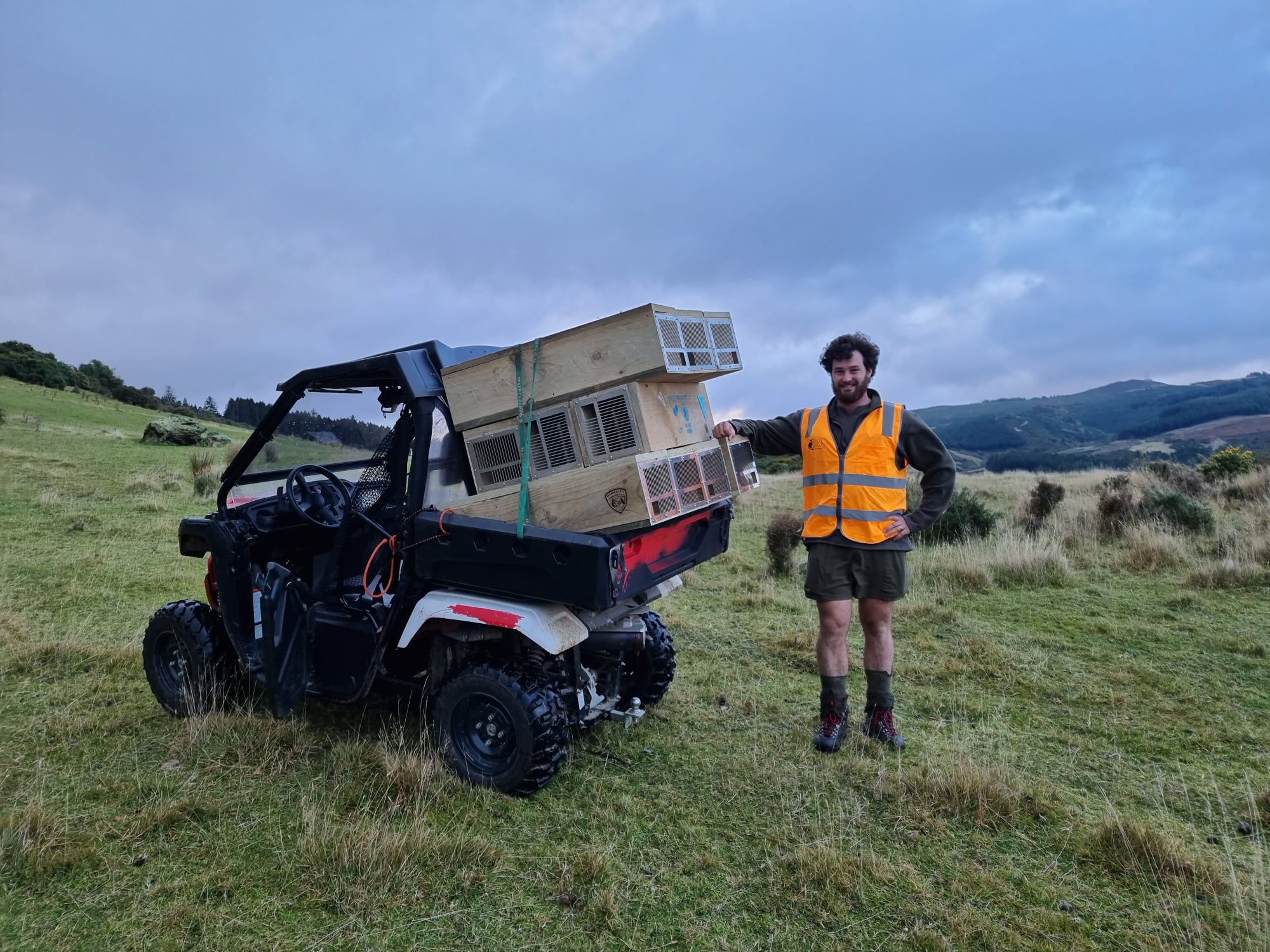
Conor is a Predator Free Project Coordinator. Here he is expanding the mustelid trapping network on Flagstaff/Te Whanaupaki. Photo supplied by Predator Free Dunedin.

Predator Free Te Kinga – strengthening the lungs of NZ

On Te Tai Poutini (the West Coast), a collective of local farmers, businesses, mana whenua, and wildlife experts have banded together to remove invasive pests from Tekimoka/Mt Te Kinga, near Lake Brunner.

Under the banner of Predator Free Te Kinga, the team have removed possums from 4000 hectares of the 18,000ha project area. They’re close to declaring another 6,500 hectares around this core area possum-free as well, and feral cats, rats, stoats, and goats will be next.

Innovation is at the heart of their approach. They are using AI supported traps that target specific predators, and heavy-lift drones to bring tunnel traps into hard-to-reach areas.

Their vision includes the reintroduction and regeneration of taonga species such as roroa/great spotted kiwi, whio/blue duck, and pāteke/brown teal.

This is part of a growing alliance of groups taking action to protect the region’s rich biodiversity and vast forests which are described as the lungs of New Zealand. Together, we are working towards a Predator Free Tai Poutini, ensuring these ecosystems are healthy and resilient for generations to come.

To detect possums and stop them from reinvading, the team have the help of dogs trained to detect the smell of possum scat. Photo supplied by Predator Free Te Kinga.

Pest Free Banks Peninsula/Te Pātaka o Rākaihautū – a community united for nature

Saying there are no possums in town is a bold statement to make, but for Pest Free Banks Peninsula/Te Pātaka o Rākaihautū, it’s not a yarn.

The locals have united to make the Akaroa township possum free, with a network of traps and bait stations across more than 130 properties. The focus is now on defending the boundaries from any stealthy possums. A dedicated team of 20 rangers also roam the surrounding hills, valleys, coastlines, paddocks and parks every single day to monitor pests.

This community-led project is supported by DOC along with local government Ngāi Tahu rūnanga, and other conservation organisations. The long-term ambition is to remove pests from 110,000 hectares of the Banks Peninsula and then gradually expand the programme onto the Canterbury Plains.

Akaroa has the can-do attitude and team culture that will be needed in all our towns and cities to make New Zealand predator-free.  
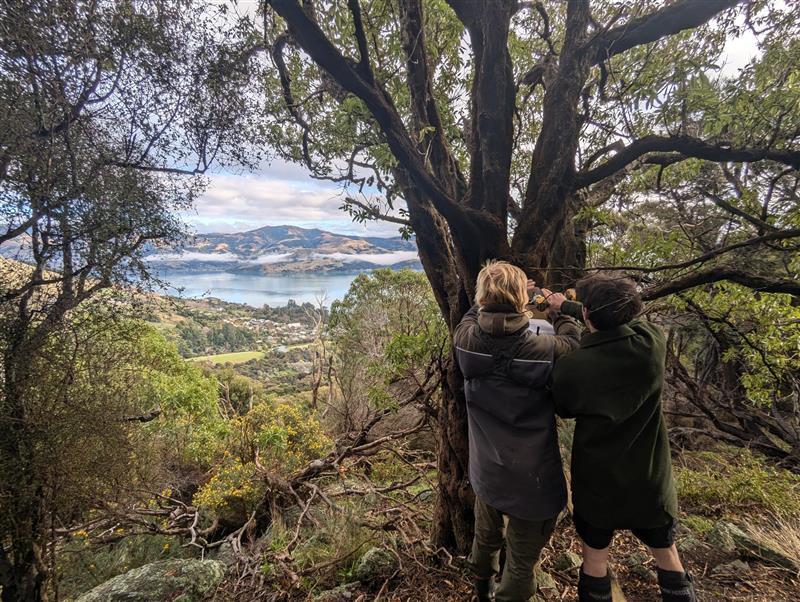
It takes a community to make a town possum-free! It’s heartening to see young people in Akaroa trapping and upskilling alongside experienced conservationists. Photo supplied by Pest Free Banks Peninsula.

Predator Free Rakiura – the largest predator eradication attempt ever

Rakiura/Stewart Island has a mix of urban and conservation land covering about 175,000 hectares. This makes it the largest, most complex environment anyone has ever attempted to eradicate predators from.

Predator Free Rakiura is being led by DOC, Zero Invasive Predators, and Te Rūnanga o Ngāi Tahu in partnership with the local community. The aim is to remove feral cats, three species of rats, possums and hedgehogs to enable kākāpō and many other threatened native species to return and flourish on the island.  

A trial was completed across 6,500 hectares in August alongside a predator control operation to save pukunui/Southern New Zealand dotterel from extinction. While the results are pending, the trial could pave the way for a larger eradication operation on the island in 2026.

What is learnt on Stewart Island/Rakiura will inform other predator free island projects across the country, including Predator Free Waiheke and Predator Free Aotea. It will also help to unlock new tools and methods for predator-free efforts on the mainland.

Rakiura is the missing link in a collection of existing predator free islands south of Bluff, including Whenua Hou/Codfish Island, Te Wharawhara/Ulva Island, Waitaua/Bench Island and most of the Tītī/Muttonbird Island chain. Further south, DOC is working to clear predators from Maukahuka/Auckland Island as well. 

We are one step closer to making Rakiura predator free with the completion of an eradication trial across a small portion of the forest. Helicopters were used to distribute bait pellets to target predators. Photo supplied by Predator Free Rakiura.

Just to name a few

For more information about some of the many other predator-free projects across the country, go to: Projects: Predator Free 2050

Learn more about how you can get involved in protecting nature: Get trapping

To find initiatives in towns, cities and remote areas across the country, see this map developed by the Predator Free New Zealand Trust: National map – Predator Free NZ Trust

Nurse-led cystoscopy clinics delivering timely cancer care in Dunedin

Source: New Zealand Government

A new nurse-led cystoscopy service at Dunedin Hospital is helping bladder cancer patients receive their essential follow-up care on time, Health Minister Simeon Brown says.

“Bladder cancer requires lifelong, regular monitoring. Timely access to surveillance cystoscopies makes a real difference for patients and their families,” Mr Brown says.

“Two highly skilled nurses are now running a weekly flexible cystoscopy clinic, carrying out surveillance procedures that keep patients on track with their care while easing pressure on specialists. 

“Since the service began in November 2024, 290 patients have been seen, with all 150 patients on the planned surveillance programme receiving their cystoscopy on time. The nurses are now completing 10 to 15 follow-ups every week.”

Around 65 per cent of Dunedin’s current follow-up cystoscopy patients are suitable for the nurse-led service. Without this change, many patients would have been overdue, and additional specialist sessions would have been needed at locum rates.

Mr Brown says the model is not only improving access for patients but also making smarter use of the workforce.

“This is a fantastic example of innovation in our health system. It ensures patients are seen when they need to be, while also freeing up specialist doctors to focus on first specialist assessments and more complex procedures. That’s a win for patients and for the wider hospital system.

“It will also play an important role in achieving our faster cancer treatment target, by helping patients get the right tests sooner and enabling treatment to begin without unnecessary delay.”

Similar nurse-led models are already in place at Counties Manukau and Waitematā, where nurse practitioners provide both diagnostic and surveillance cystoscopies.

“This initiative shows the value of empowering our skilled nursing workforce. By making better use of their expertise, we are improving access to care, supporting our specialists, and making sure patients receive timely, quality treatment,” Mr Brown says. 

Remarkable reduction in youth offending

Source: New Zealand Government

A ‘tough but fair’ approach, and greater unity across both our communities and government, is keeping people and property safer. 

Minister for Children Karen Chhour has confirmed a strong reduction in children and young people with serious and persistent offending behaviour dropping month-on-month since June 2024, a remarkable turnaround for what was once a national crisis. 

“As I tour the country, I am consistently hearing that communities are feeling safer. 

We promised to fix what matters to New Zealanders. We had been told that people felt unsafe, and that young people were going down the wrong path and harming their communities and their futures. 

This significant reduction in serious and persistent youth offending is just one example of how we’re fixing what matters. 

Community leaders are confirming to me that they are seeing the results on the ground, with young offenders no longer feeling above the law. 

Ram raids are down significantly. Kiwis are no longer being expected to live in fear that our cars have been stolen used by young offenders in a ram raid of our local small businesses.

Repeat offending has also decreased, with innovative initiatives like the Military-Style Academies and greater collaboration between Oranga Tamariki and Police getting results.”

The number of serious and persistent child and youth offenders is 14.6 percent lower than in June 2023, with current trends pointing to this continuing towards achieving Government Target Three several years before the target date.  

“I have also been informed that repeat young offenders are avoiding re-offending because they know Courts, Oranga Tamariki, and Police are working together more closely. They no longer believe they can avoid accountability and that their actions won’t have consequences.

We are investing in a number of safety and quality improvements to the facilities at youth justice residences, as well as greater investment in transitional support for young serious offenders. 

These investments from Budget 2025 will reduce both re-offending and the number of young people being held in police custody for an extended period of time. 

The reality is that there are times when that is the most appropriate place for them to be. I do not apologise for that. 

I hope these young offenders turn their lives around, and they are provided with opportunities to do so, but the safety of the community and victims is our highest priority,” Mrs Chhour says.     

Promoting resilience and insurance ties in London

Source: New Zealand Government

Commerce and Consumer Affairs Minister Scott Simpson travels to London this week to strengthen New Zealand’s international partnerships in insurance, emergency preparedness, and business competition.

“Resilience and disaster recovery are central priorities for this Government. My visit to London is an opportunity to promote New Zealand’s leadership in these areas, and to build stronger ties with global partners who share our challenges and ambitions,” Mr Simpson says.

The Minister will attend meetings involving the Insurance Council of New Zealand, including with Aon, Lloyd’s of London, and the UK Competition and Markets Authority.

Mr Simpson will also receive a detailed briefing from officials at the New Zealand High Commission, and take part in a series of events reflecting the breadth of New Zealand’s relationship with the United Kingdom.

This includes attending the 85th Anniversary Battle of Britain Service and Reception and supporting the Black Ferns in their Women’s Rugby World Cup semi-final against Canada.

Minister Simpson will be in London from 17–21 September.

Flare requirements: what you need to know

Source: Maritime New Zealand

We’ve received a few queries about the use of LED flares on commercial vessels, prompted by the circulation of some incorrect information.

Maritime NZ continues to apply the existing standards – there have been no recent changes to the regulations on flares.

What the current maritime rules say:

  • Commercial vessels are required to carry traditional pyrotechnic flares, unless the operator holds a specific exemption.
  • These requirements are set out in Maritime Rule 42A.23 and the relevant Part 40 tables for life-saving appliances.
  • Pleasure craft may carry LED flares, as the regulations do not prescribe performance standards or carriage requirements for these vessels.

For more information on distress flares see this webpage.

If you’re unsure what applies to your vessel, our team is happy to help – just get in touch.

Review of sustainability measures for fisheries – October 2025 round

Source: NZ Ministry for Primary Industries

Updates 

23 July 2025 – Consultation extended a week

Fisheries New Zealand has received requests from some submitters seeking an extension to the closing date for this consultation. We want to ensure adequate time is provided for everyone who has an interest in the review of these stocks to thoroughly consider the proposed options. We will now accept submissions until 5pm on 30 July 2025.

July 2025 – Proposed changes for orange roughy (ORH 3B) and blue mackerel (EMA 1)

Fisheries New Zealand is also proposing changes to sustainability measures for orange roughy (ORH 3B) and blue mackerel (EMA 1) for the 2025/26 fishing year. Details of these proposals can be found on a separate web page:

Review of sustainability measures for orange roughy (ORH 3B) and blue mackerel (EMA 1) – 2025 October round

Note that submissions on ORH 3B and EMA 1 now close at 5pm on 30 July 2025.

About this consultation

Fisheries New Zealand reviews catch limits for selected stocks twice a year. This is consistent with the purpose of the Fisheries Act 1996 to allow for sustainable utilisation.

We’re seeking feedback on proposed changes to sustainability measures for a range of fish stocks as part of the October 2025 sustainability round.

Fisheries New Zealand is currently reviewing catch limits and allowances for:

  • Anchovy (ANC 1), Garfish (GAR 1), Sprat (SPR 1), Yellow-eyed mullet (YEM 1) – Hauraki Gulf, Northland, Auckland, Bay of Plenty
  • Jack mackerel (JMA 1) – East Coast North Island
  • Smooth skate (SSK 1) – Auckland, Northland, Bay of Plenty, West Coast North Island
  • Blue cod (BCO 8) – Taranaki, West Coast of Wellington
  • Paua (PAU 2) – East Cape, Hawke’s Bay, Taranaki & Wellington
  • Paua (PAU 5A) – Fiordland
  • Rough skate (RSK 3) – East Coast South Island
  • Rig (SPO7) and Snapper (SNA 7) – West Coast and top of the South Island
  • Green-lipped mussel (GLM 7), Horse mussel (HOR 7), and Oyster (OYS 7) – Top of the South Island
  • Blue cod (BCO 3) – East Coast South Island
  • Blue cod (BCO 5) – Southland
  • Blue mackerel (EMA 7) – West Coast North Island, West Coast South Island
  • Gemfish (SKI 3 & 7) – South Island, Chatham Islands, West Coast off Taranaki & Wellington
  • Silver warehou (SWA 3 & 4) – East Coast South Island, Southland, Chatham Islands, Sub-Antarctic
  • Leatherjacket (LEA 1), Frostfish FRO 1), Alfonsino (BYX 7), Dark ghost shark (GSH 7), Redbait (RBT 3) – East and West Coasts of Auckland, Northland, Waikato, and Bay of Plenty, West Coast and top of the South Island (inshore and offshore), East Coast South Island (offshore)

We are also reviewing deemed value rates for:

  • Snapper (SNA 7) – West Coast and top of the South Island
  • Blue mackerel (EMA 7) – West Coast North and South Island
  • Rig (SPO 7 & 8) – West Coast and top of the South Island, West Coast off Taranaki & Wellington
  • Blue cod (BCO 3) – East Coast South Island
  • Gemfish (SKI 3 & 7) – South Islands, Chatham Islands, West Coast off Taranaki, Wellington
  • School shark (SCH 5) – Southland and Sub-Antarctic

Fisheries New Zealand is also reviewing sustainability measures for Orange roughy (ORH 3B) and blue mackerel (EMA 1) as a part of this sustainability round. Consultation on the proposed changes for these stocks is expected to begin by the end of June.

Have your say

We invite feedback from tangata whenua, stakeholders, and the public on the proposals.

All of the proposals in this round were assessed:

  • in the context of the relevant statutory requirements
  • using the best available information, including the latest scientific information on the status of the stocks and tangata whenua and stakeholder input.

Full details are provided in the consultation documents. This web page also has a summary of the proposals.

The closing time and date for submissions on all proposals is 5pm on 30 July 2025.

Summary of the proposals and consultation documents

Species

Stock/area

Proposal

Consultation document

Anchovy, Garfish, Sprat and Yellow-eyed mullet

ANC 1

TAC ↓

Review of sustainability measures for anchovy (ANC 1), garfish (GAR 1), yellow-eyed mullet (YEM 1), and sprat (SPR 1) for 2025/26 [PDF, 1.5 MB]

GAR 1

TAC ↓

SPR 1

TAC ↓

YEM 1

TAC ↑

Jack mackerel

JMA 1

TAC ↓

Review of sustainability measures for jack mackerel (JMA 1) for 2025/26 [PDF, 1.2 MB]

Smooth skate

SSK 1

TAC ↑

Review of sustainability measures for smooth skate (SSK 1) for 2025/26 [PDF, 1.1 MB]

Blue cod

BCO 8

TAC ↓, Recreational changes

Review of sustainability measures for blue cod (BCO 8) for 2025/26 [PDF, 1.4 MB]

Pāua

PAU 2

TAC ↓

Review of sustainability measures for pāua (PAU 2) for 2025/26 [PDF, 1.4 MB]

Pāua

PAU 5A

TAC ↓

Review of sustainability measures for pāua (PAU 5A) for 2025/26 [PDF, 1.6 MB]

Rough skate

RSK 3

TAC ↓

Review of sustainability measures for rough skate (RSK 3) for 2025/26 [PDF, 1.3 MB]

Rig and Snapper

SPO 7

TAC ↑

Review of sustainability measures for rig (SPO 7) and snapper (SNA 7) for 2025/26 [PDF, 1.6 MB]

SNA 7

TAC ↑

Green-lipped mussels, Horse mussels, and Dredge oysters

GLM 7A

TAC ↓

Review of sustainability measures for green-lipped mussels (GLM 7A), horse mussels (HOR 7), and dredge oysters (OYS 7) for 2025/26 [PDF, 1 MB]

HOR 7

TAC ↓

OYS 7

TAC ↓

Blue cod

BCO 3

TAC ↓ Recreational changes

Review of sustainability measures for blue cod (BCO 3) for 2025/26 [PDF, 1.3 MB]

Blue cod

BCO 5

Recreational changes

Southland recreational blue cod review: Daily limit review and potential measures to improve the health of the BCO 5 fishery [PDF, 1 MB]

Blue mackerel

EMA 7

TAC ↑

Review of sustainability measures for blue mackerel (EMA 7) for 2025/26 [PDF, 1.4 MB]

Gemfish

SKI 3

TAC ↑

Review of sustainability measures for gemfish (SKI 3 and SKI 7) for 2025/26 [PDF, 1.3 MB]

SKI 7

TAC ↑

Silver warehou

SWA 3

TAC ↑

Review of sustainability measures for silver warehou (SWA 3 and SWA 4) for 2025/26 [PDF, 1.3 MB]

SWA 4

TAC ↑

Leatherjacket, Frostfish, Alfonsino, Dark ghost shark and Redbait

LEA 1

TAC ↓

Review of sustainability measures for 5  low-medium knowledge stocks for 2025/26 [PDF, 1.6 MB]

FRO 1

TAC ↓

BYX 7

TAC ↓

GSH 7

TAC ↓

RBT 3

TAC ↑

Snapper, School shark, Rig, Blue cod, Blue mackerel and Gemfish

SNA 7

DVs ↓

Review of deemed value rates for selected stocks for 2025/26 [PDF, 2.3 MB]

SCH 5

DVs ↓

SPO 7, SPO 8

DVs ↑

BCO 3

DVs ↑

EMA 7

DVs ↓

SKI 3, SKI 7

DVs ↓

Supporting document

Information on the interpretation and application of the statutory considerations relevant to TAC decisions is in the Legal Appendix.

Legal Appendix: Overview of legislative requirements and other considerations in relation to sustainability measures, October 2025 round [PDF, 389 KB]

Making your submission

Fisheries New Zealand invites you to email your feedback on the proposals by 5pm on 30 July 2025 to FMsubmissions@mpi.govt.nz

A template is available to help you complete your submission.

Submission form template [DOCX, 78 KB]

While we prefer email, you can post written submissions to:

2025 Sustainability Review
Fisheries Management
Fisheries New Zealand
PO Box 2526
Wellington 6140
New Zealand.

What to include

Make sure you tell us in your submission:

  • the title of the consultation document
  • your name and title
  • your organisation’s name (if you are submitting on behalf of an organisation, and whether your submission represents the whole organisation or a section of it)
  • your contact details (such as phone number, address, and email).

Related information

Fisheries Act 1996 – NZ Legislation

Hauraki Gulf Marine Park Act 2000 – NZ Legislation

About the Quota Management System (QMS)

The Harvest Strategy Standard [PDF, 240KB]

Operational Guidelines for New Zealand’s Harvest Strategy Standard [PDF, 843 KB]

The Deemed Values Guidelines [PDF, 896 KB]

Glossary of relevant terms

National Fisheries Plan for deepwater and middle-depth fisheries [PDF, 1.4 MB]

Regional plan provisions and policy statements [PDF, 324 KB]

Fisheries Infosite

Fisheries Assessment Plenary

National Inshore Finfish Fisheries Plan [PDF, 10 MB]

Submissions are public information

Note that all, part, or a summary of your submission may be published on this website. Most often this happens when we issue a document that reviews the submissions received.

People can also ask for copies of submissions under the Official Information Act 1982 (OIA). The OIA says we must make the content of submissions available unless we have good reason for withholding it. Those reasons are detailed in sections 6 and 9 of the OIA.

If you think there are grounds to withhold specific information from publication, make this clear in your submission or contact us. Reasons may include that it discloses commercially sensitive or personal information. However, any decision MPI makes to withhold details can be reviewed by the Ombudsman, who may direct us to release it.

Official Information Act 1982 – NZ Legislation

Government takes action on Bird Flu preparedness plan

Source: New Zealand Government

New proposals for a long-term approach to manage high pathogenicity avian influenza (HPAI) H5N1, commonly known as Bird flu, aim to reduce the impacts on poultry if the virus arrives here, says Biosecurity Minister Andrew Hoggard.

“This virus is spreading rapidly across the world. If it arrives here, it will almost certainly establish itself in wild birds and could spread to poultry and other wildlife.”

“That could mean shortages of chicken and eggs for Kiwi families, serious animal welfare issues, and costs for farmers and growers. Our focus is on protecting people’s livelihoods and keeping food on the table.”

The Ministry for Primary Industries (MPI) is leading work to prepare for the possible arrival of HPAI H5N1, along with the Department of Conservation, the Ministry of Health, Health New Zealand | Te Whatu Ora, the poultry industry and local government.

Consultation opens today on proposals to manage HPAI H5N1 in poultry, including:

•    a requirement for commercial poultry operators to have an avian biosecurity control programme in place that sets out how their business will prevent and manage a potential H5N1 outbreak 
•    a requirement for poultry operators/owners to meet appropriate biosecurity standards, including standards for activities such as depopulation, disposal, cleaning and disinfection
•    a requirement for operators/owners to keep records and provide information when required 
•    a requirement that avian biosecurity programmes be audited to ensure they are fit for purpose
•    establishing offences and penalties (fines) for those who do not comply with the regulations.

“Since it emerged in 2020, the virus has spread across the globe except to Australia, New Zealand, and the South Pacific. Our efforts so far have paid off, we need to keep it that way.”

“We need a long-term approach to managing the disease that incentivises good biosecurity practices and early reporting of infection, protects human health and the domestic food supply, and provides for consistent standards across the industry.”

Some of the proposed regulations could also apply to semi-commercial poultry operators and non-commercial poultry owners – people who keep poultry but not as a main source of income. For example, these poultry owners could be required to use specific disposal or cleaning methods and provide information to MPI if their birds get sick.

“We know these proposals are likely to involve costs and other impacts for commercial poultry operators. We want to hear from farmers and growers about how the proposals could affect their businesses, so we can understand the impact of these costs.”

“By working together now we can reduce the risks of bird flu preventing food shortages, affecting people’s livelihoods, and endangering health outcomes. This is your chance to help make sure New Zealand is ready.”

Consultation will run for six weeks from 17 September 2025 to 2 November 2025.     

Discussion documents and information on how to make a submission are on MPI’s website here.
 

Cost recovery proposals under the Organic Products and Production Act 2023

Source: NZ Ministry for Primary Industries

Updates

15 July 2025 – Closing extended

The consultation has now been extended for another 4 weeks. This will now close on 10 August 2025.

10 June 2025 – Registrations open for webinars or drop-in sessions

We have set up 3 webinars or drop-in sessions to support the public consultation process for the organic sector, providing a forum to answer any questions. The webinar times are provided below. You can register by clicking on the link of your preferred time. (The registration links are to a booking system using ‘Microsoft Teams’).

Monday 16 June 2025 – 3.30pm to 5.30pm

Tuesday 17 June 2025 – 12pm to 2pm

Tuesday 24 June 2025 – 8.30am to 10am

6 June 2025 – Discussion document updated

The following corrections have been made to the table in section 11.1.2 of the discussion document:

  • added definition of terms for [d] (page 24), previously missing from table
  • corrected labelling of definition of terms for [j] and [k] (page 26), previously mislabelled as [e] and [f].

See the discussion document

Background information: summary

In 2023, Parliament passed the Organic Products and Production Act 2023 (the Act) to regulate organic claims in New Zealand. The Act sets the requirements for making an organic claim and enables the development of secondary legislation to regulate how organic products are made in New Zealand. The new regulatory system is intended to provide consumer confidence in the claims made by New Zealand producers of organic products, and confidence and certainty in the trade of organic products for New Zealand businesses and our trading partners. It will also form the basis of negotiations to gain access to other markets for New Zealand’s organic produce.

To fund the system, MPI must recover costs not covered by the Crown. We anticipate cost recovery for some businesses will begin in mid-2026 to ensure that we can bring operators into the system within the timeframes required to maintain access to the European Union (EU) and Switzerland for organic products.

The services discussed in the consultation document have been identified as necessary to administer the Act with an appropriate level of oversight. We seek your views on whether you think the range and level of services are appropriate (the right type and size), and if the charging mechanism is appropriate, for example the fee or levy. The proposed fees would apply to direct services, while levies would fund broader sector benefits.

Have your say

We are seeking your input on the cost recovery proposals for services that include:

  • approval (certification)
  • oversight, support, and monitoring services for the standard
  • work to facilitate the export of organic products.

The proposals affect all businesses which make organic claims about food, beverages, and plant and animal products.

Full details are in the consultation document.

You can send us your submission by 10 August 2025.

Consultation document

Proposal to cost recover New Zealand Food Safety’s regulatory services under the Organic Products and Production Act 2023 [PDF, 2.9 MB]

Related document

This information was originally published in 2023 and detailed the organic regulation requirements agreed to by Cabinet. There have been minor tweaks to the information to better reflect progress on developing the National Organic Standard and process regulations.

Information sheet A3 [PDF, 540 KB]

Making your submission

We must get your submission by 5pm on 10 August 2025.

We seek to understand your views on the nature and benefits of the services discussed in the consultation document, the cost of the services, and how they are proposed to be funded (and by whom).

We prefer you to use our online form but you can also email or post your feedback. 

Email

organicsconsultation@mpi.govt.nz

Post

Cost Recovery Directorate
Ministry for Primary Industries
PO Box 2526
Wellington 6140.

Submissions are public information

Note that all, part, or a summary of your submission may be published on this website. Most often this happens when we issue a document that reviews the submissions received.

People can also ask for copies of submissions under the Official Information Act 1982 (OIA). The OIA says we must make the content of submissions available unless we have good reason for withholding it. Those reasons are detailed in sections 6 and 9 of the OIA.

If you think there are grounds to withhold specific information from publication, make this clear in your submission or contact us. Reasons may include that it discloses commercially sensitive or personal information. However, any decision MPI makes to withhold details can be reviewed by the Ombudsman, who may direct us to release it.

Official Information Act 1982 – NZ Legislation

High hazards newsletter – September 2025

Source: Worksafe New Zealand

Welcome to the eighth WorkSafe High Hazards newsletter.

In this issue we cover:

  • Introduction from Pelin Fantham, Chief Inspector High Hazards 
  • New major hazard facility (MHF) Notifiable Incident form 
  • MAHB Common Inspection Criteria 
  • Incident insights – coupling failures trend 
  • Safety Case Statistics 
  • Final Reminder – PFAS firefighting foam transitional period ending 
  • HHU incident data and frequency 
  • In the news

Read the full newsletter(external link)