New commercial fish-landing rules come into force

Source: NZ Music Month takes to the streets

Common sense new rules allowing certain species of live fish to be legally returned to the sea will reduce unnecessary red tape and support sustainability, Oceans and Fisheries Minister Shane Jones says.
Under the Quota Management System most fish caught by commercial fishers must be kept and taken to shore unless there is an exception in place.
The new rules exempt southern bluefin tuna, legal-sized pāua and Bluff oysters from this requirement as long as they are alive and likely to survive being returned to sea.
“Returning these species to their fisheries in circumstances when they are likely to survive benefits the sustainability of fish stocks as returned fish will remain part of the spawning population,” Mr Jones says.
“Commercial fishers have been allowed to return southern bluefin tuna since 2004 but these new rules set out the conditions in which they are likely to survive.
Under the new exception, commercial fishers can return southern bluefin tuna only if it has been caught by surface longline or troll, is confirmed to be alive, without major injury, and is returned to the sea as soon as possible. 
“Commercial pāua fishers have put in place voluntary minimum harvest sizes, which are larger than the minimum legal size. These voluntary measures from industry support sustainability of pāua fisheries by maintaining a larger amount of spawning pāua in the fishery,” Mr Jones says. 
“The exception will allow commercial pāua fishers to return pāua that are larger than the legal size, but smaller than the voluntary harvest size, which supports efforts to look after the fisheries they depend on.”
The change allowing oysters to be returned to the sea is a practical response to how they grow, Mr Jones says.
“Oysters grow in clumps, which can include both legal and undersized oysters. Without the exception, undersized oysters must be removed from the legal-sized ones and returned to the sea.
The exception requires legal-sized oysters, if attached to such a clump, to be returned to the water quickly as possible as well.
“Bluff oysters need to be returned to the sea quickly for them to have the best chance of surviving, so the handling time needed to separate the undersized oysters hurts their chances of surviving to grow and spawn more oysters.”
“My thanks to everyone who provided feedback as part of the consultation on these changes,” Mr Jones says.
The commercial landing exceptions come into force on 1 May 2025.

Ranger’s dream to protect an ancient kānuka ‘island’

Source: Police investigating after shots fired at Hastings house

Date:  30 April 2025

The 13-hectare forest near Eyrewell in North Canterbury is in the Motu Kānuka Scientific Reserve, which sits within a vast sea of privately owned farmland.

DOC Biodiversity Ranger Christina Stet says when she’s sitting in the middle of the kānuka forest island or motu on the flat expanse of the plains, she feels like she’s travelled back hundreds of years.

“Everything around it has been cleared, and yet amazingly this motu has remained. It’s an incredibly special ecosystem and provides a home for many threatened and at-risk species, shrubs, lichen, moss, insects, lizards, and birds. I feel very passionate about protecting it as many of these species are extremely rare on the Canterbury Plains.”

DOC purchased the forest through the Nature Heritage Fund in 2019. There were many threats to contend with including introduced grasses, gorse, broom, and pests, which impact the native plants and animals. It was pure luck the native kānuka forest had survived for so long.

Christina and DOC’s biodiversity team had a challenge. How could they protect the existing forest and increase its size by encouraging more kānuka to grow?

“We heard ECAN (Environment Canterbury) was trialling a new technique of reforestation in kānuka reserves. The idea was to try and create a giant ‘seed tray’. With help from their biodiversity fund, we cleared the invasive grasses near the adult trees and hoped the kānuka seeds would be blown across and land on the cleared soil and grow. The famous Canterbury nor’ wester blew and suddenly, these little seedlings started sprouting. I was so stoked to see how they’ve thrived.”

Christina says they hope to create a ‘seed tray’ on another side of Motu Kānuka.

“The bigger the buffer we can make, the more resilient the forest will be. What I love is being able to make a difference. We’ve proven in many parts of the country that when we remove or manage the threats to nature or restore habitats, they come back and thrive. Every individual action counts,” she says.

“We want to make sure this little ancient island stays this way for generations to come as once it disappears, it’s gone for good. This is part of our heritage and a wonderful snapshot of the past. This motu is a reminder of the resilience of nature, but more often now, it needs a helping hand.”

The Motu Kānuka Scientific Reserve requires a permit to visit.

Watch a video of Christina Stet in the Motu Kānuka.

A second video of Christina explaining how her giant ‘seed tray’ works is also available via DOC’s social media channels.

Contact

For media enquiries contact:

Email: media@doc.govt.nz

Reawakening Manu-kau Noa Iho / Hayman Park

Source: Secondary teachers question rationale for changes to relationship education guidelines

From late April to December 2025, parts of Hayman Park in Manukau will be temporarily closed for work to further enhance its green spaces.

This will finish the full upgrade of the park and go well with the much-loved playground, which was upgraded in 2023.

Upgraded Manu-kau Noa Iho / Hayman Park playground, completed in 2023. Image: Eke Panuku.

Once a thriving wetland that filtered water before it reached Waipuhinui (Puhinui Stream), and the Manukau Harbour, Manu-kau Noa Iho / Hayman Park was a vital hub for native fish, birds, insects, and plants.

Working alongside Te Ākitai Waiohua, Ngaati Tamaoho, and Ngaati Te Ata Waiohua, Auckland Council’s Healthy Waters and flood resilience teams, the Ōtara-Papatoetoe Local Board and Eke Panuku Development Auckland are bringing this natural taonga (treasure) back to life. Rejuvenating the land and its ecosystems, preserving it as a thriving, living space for future generations.

The Manu-kau Noa Iho / Hayman Park Wetland project is a part of the Puhinui Regeneration Strategy, this project is led by Eke Panuku and proudly supported by the Ōtara-Papatoetoe Local Board.

Manukau Ward Councillor Lotu Fuli says, “This incredible project, over a decade in the making, would not be possible without the hard work of our Mana Whenua, Eke Panuku, Healthy Waters and Flood Resilience, the design team, and the wider Auckland Council whānau. A special thanks to the Ōtara-Papatoetoe Local Board for their ongoing advocacy and leadership. As we restore the land to its original wetland form, we ask for the community’s patience and understanding. Some areas of the park will be closed, so please respect the barriers for safety during this important work.”

Manu-kau Noa Iho / Hayman Park Repo (wetlands) project will rejuvenate the land and its ecosystems – keeping Manukau’s green heart healthy for future generations. Image: Eke Panuku.

Ōtara-Papatoetoe Local Board Chair Apulu Reece Autagavaia adds, “Currently there is a stagnant dead pond located on the park. It serves no purpose. Under this project, the wetlands will be revived, and we hope a habitat for our flora and fauna to live and thrive in. This is whakaoranga – bringing back to life.”

A whakaawatea karakia (blessing) in action. Image: Eke Panuku.

Manu-kau Noa Iho / Hayman Park holds deep cultural significance, particularly for local iwi Te Ākitai o Waiohua, Ngaati Te Ata Waiohua, and Ngaati Tamaoho.

A stunning shot of the whakaawatea karakia (blessing). Image: Eke Panuku.

Richard Davison, Priority Location Director at Eke Panuku says “This project has been a long time in the making, and it’s incredibly special to see it come to life. Hayman Park has always been the green jewel at the heart of Manukau, and now we’re helping it shine even brighter.”

From the park to the Auckland Botanic Gardens and beyond, new walking and cycling connections are being strengthened, along with deeper ties to nature.

Artist impression of the revived wetlands at Manu-kau Noa Iho. Image: Eke Panuku.

Why does this work need to be done?

Manu-kau Noa Iho / Hayman Park’s stormwater ponds were originally built in 1975 as part of the former Manukau City Council’s development of the city centre.

Over time, issues with sediment build-up, bank stability and litter have begun to cause problems with the ponds. It was agreed that a natural treatment process in the form of a wetland and installing a litter-capturing device would deliver the most effective solution for a cleaner, healthier environment.

What features are planned?

  • A new repo (wetland) filled with native planting and rich in wildlife habitat that will improve water quality before it flows into Te Puhinui and the Manukau Harbour

  • Replacing the existing ornamental pond with a new grass area for people to rest, enjoy or that can be activated through small events

  • Build wider footpaths, boardwalks, and viewing platforms to help people reconnect with nature.

These features will help to clean stormwater before it flows into the Puhinui Stream and Manukau Harbour.

A nice view of the park featuring a calm pond area. Image: Eke Panuku.

Stay up to date 

Sign up for your Local Board E-news and get the latest news and events direct to your inbox each month. Or follow us on Facebook.

Pilot project delivers promising results for sustainable urban design

Source: Secondary teachers question rationale for changes to relationship education guidelines

Advocates for living roofs, those lush, plant-covered patches of green on our city buildings, have long championed these slices of eco-paradise in our urban jungle. Now, thanks to a pioneering project between Auckland Council and the University of Auckland, we have the data to prove their value.

The Living Roof Monitoring project was launched to assess how well these verdant rooftops perform compared to conventional ones. After months of careful monitoring, the results highlight their effectiveness as a sustainable urban solution.

Stormwater superstars

Auckland Council’s Senior Healthy Waters Specialist Rachel Devine highlights the global success of integrating nature into urban infrastructure. She explains that planting vegetation on rooftops is one of the ways that cities can effectively absorb rainfall, reduce flooding and mitigate the stormwater network from becoming overwhelmed.

“But now, having the local data to back this up gives us context that is relevant to Auckland’s climate and environment,” Ms Devine says.

University of Auckland Professor Asaad Shamseldin who leads the research with Dr Kilisimasi Latu and Dr Conrad Zorn, is pleased with the robust dataset collected by the team’s PhD students Aung Naing Soe and Sihui Dong, which focuses on assessing the benefits of plants over conventional coverings on rooftops.

Their findings show living roofs significantly reduce stormwater runoff, with some substrate types retaining nearly 80 per cent of rainfall, even during heavy downpours. And that almost every drop is retained in light rainfall, demonstrating the excellent absorption potential of these gardens.

Chair of the Policy and Planning Committee Councillor Richard Hills says the findings of this research are very promising for roof gardens, helping to prevent flooding and water pollution in built-up urban areas like the inner city. 

“This preliminary research indicates that if we could retrofit roof gardens all over Auckland’s city centre it would not only enhance our place as a clean green city on the global stage but would also be a viable aid in reducing heat and help prevent or reduce flooding in parts of the city centre.

“It would also make the city look more beautiful for residents in high rise apartments, staying in hotels or working in offices and provide tangible environmental benefits, including providing habitats for native plants and birds.

“Stormwater run-off in the city centre also contributes to the pollution of the Waitematā and the Hauraki Gulf, and these findings point to roof gardens curtailing much of this run-off into our precious oceans and harbours.

Nature’s air conditioner: cooling our concrete jungles

Professor Shamseldin adds it is important to remember living roofs aren’t just about stormwater management; they are also very effective at keeping things cool.

“When urban temperatures rise, green roofs act like nature’s air conditioners,” says Professor Shamseldin.

In Auckland’s hottest months, when temperatures can exceed 25°C, the data shows living roofs lower rooftop surface temperatures by an impressive 32 per to 56 per cent. The research even uncovered a surprising ally in urban cooling: the wind.

“During the day, sea breezes help cool green roofs and delay peak temperatures, while at night, city-to-sea winds help reduce the temperature difference between green and conventional rooftops,” explains Associate Professor Shamseldin.

This translates to tangible energy savings for buildings and a potential reduction in the Urban Heat Island effect – truly, a breath of fresh air from above.

A living legacy: onshore islands

The pilot study was inspired by Auckland’s Central City Library living roof, a project developed in partnership with Ngāti Whātua Ōrākei that was launched five years ago.

Featuring over 2,000 hardy native plants, the roof reflects a shared commitment to enhance urban biodiversity and live in harmony with te taiao (the natural world).

Native grasses flourishing in the Auckland Central Library living roof.

“Kaupapa like this green roof are examples of cultural infrastructure, they integrate nature into our cities and allow us to actively elevate the mauri of our taiao,” says Etienne Neho of Ngāti Whātua Ōrākei.

Greener cities, smarter cities: a vision for the future

This collaboration already has the potential to influence Auckland’s future. By providing policymakers and urban planners with data, the project can inform smarter, greener development decisions that enhance urban environments.

“If we want to create a sustainable, healthy city, one that future generations can enjoy – working with nature is a must,” adds Ms. Devine.

“These results prove what we’ve long suspected: nature-based solutions can help our journey towards becoming a more sustainable and resilient city.”

The research team continues to monitor additional biodiversity benefits, and more updates will follow as the data flourishes. Although urbanisation and climate change present numerous challenges, one thing is certain, working with nature is a positive step towards a healthier urban environment.

We want to be here long-term: A 20-year journey towards sustainable dairy farming

Source: PISA results continue to show more to be done for equity in education

Reducing nitrate in the water

And slowly but surely, it’s paid off. The 221ha property with 630 cows, located on the outskirts of Culverden in the Amuri Basin, had seen a significant reduction in nitrate in the water and a dramatic improvement to the health of its ecosystem. But those results didn’t come overnight.

The team at Pukatea Dairy Farm had spent the last two decades investing in:

  • draining systems
  • sediment traps
  • riparian planting, particularly around the wetlands.

Water testing showed that the level of nitrogen that came into the farm was reduced by 95 per cent after it was filtered through the drains and wetland.

Stuart said they wanted to be sustainable, resilient and offer a meaningful experience for everyone involved in the operation.

“I think sometimes there’s a bit too much focus on short-term profit in farming and I get that, I used to be a sharemilker, but what we’ve learnt is you can forgo a little profit to make yourself more resilient later.”

In the last few years, the weather demonstrated that. The farm produced results even in years with challenging conditions.

The farm was fortunate to have heavier soils than other parts of the basin, which meant they had greater drought resilience. But heavier soils meant keeping a careful balance with soil moisture monitoring.

“We worked out that our pasture doesn’t like being wet all the time,” Stuart said.

Reducing the farm’s carbon emissions

Another significant change was steering away from a more intensive farm system. This move was driven by a desire to prioritise animal welfare and create a more enjoyable work environment. In return, it has improved both the herd’s health and the farm’s overall sustainability.

Stuart said one of the big issues with dairy farming was intensity, which translated to how many cows and how much brought-in feed you had in your system.

“[It’s] about your carbon footprint, your environmental effects and what we are trying to do is run within the capacity of the land. I think the data is showing that we are not far away.”

Over the last ten years, Stuart reduced the number of cows in his paddock from 700 to 630. Three years ago, he took deintensification further by decreasing the number of weekly milkings from 14 to ten.  

In turn, this decreased his replacement rate (the number of cows he kept as a buffer to replace the cows that couldn’t get pregnant) from 25 to 18 per cent and halved the farm’s empty cow rate. 

Recognition for sustainable and ethical farming

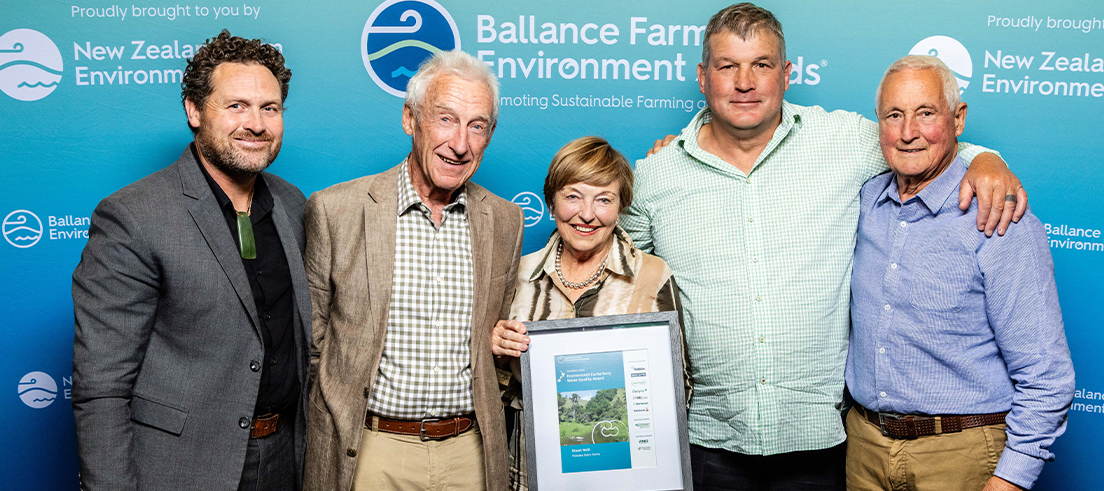
Ballance Farm Environment Awards (BFEA) judges commended Stuart and his team for creating an outstanding operation that consistently chose the right path over the easy one.

The judges said the farm’s long-term environmental initiatives, strategic grazing practices, and unwavering commitment to ethical, sustainable farming served as an inspiration to others in the industry.

Stuart also took home:

  • The Environment Canterbury Water Quality Award
  • The Dairynz Sustainability and Stewardship Award
  • The FMG Risk Management Award.

Our Water and Land Northern Team Leader, Andrew Arps, said what stood out to him was the enduring nature of their efforts, as it hadn’t been a quick or easy journey.

“It’s been about consistent, thoughtful improvements, with a focus on sustainable land management that goes well beyond regulatory requirements.”

“One of the powerful things about Stuart’s approach is that it recognises how small actions, when done collectively and consistently, can make a real and lasting difference for water quality and land health. It’s a mindset that doesn’t chase short-term fixes but looks at the bigger picture, and it’s clear that this way of working is paying off.”

Andrew said Stuart’s success reflected the input of those around him as he was open to advice, willing to consider different perspectives, and not afraid of robust discussions to find the best way forward.

“That kind of leadership and collaboration is exactly what we need more of across the region.

“All of this made Stuart a very deserving recipient of our water quality award. His work sets a great example for others.”

Further reading

New principals’ success is everyone’s responsibility

Source:

Responding to an Education Review Office report about principals who had been in the role five years or less, Kate Gainsford says the report is very welcome and timely.

“It’s heartening to see in the report that new principals are more likely to be Māori, younger, female and representative of diverse cultures and ethnicities.  Schools definitely need principals who reflect the changing face of Aotearoa New Zealand.

“It’s imperative, for our ākonga, that new principals are given the development and support they need to ensure they can lead schools as effectively as possible.

“We all – the Ministry, school boards, communities, teacher unions and fellow principals – need to share the responsibility for ensuring new principals can meet the significant challenges ahead and we each have a different part to play.   Boards can develop good, thorough and consistent induction processes. Principal colleagues can ensure professional networks meet regularly with all the opportunities to collaborate that they provide. Education agencies can work together to ensure aspiring principals have pathways that include good preparation for the role. 

“From the centre – from government, there needs to be clear leadership and direction to achieve the best combination of professional support and development for aspiring leaders. There are very good and very able people out there. The education system needs  to make sure they are well prepared for school leadership roles. 

“No school is an island, we are all here to do the very best we can for our ākonga and the more we can help each other, the better for everyone.”

Last modified on Thursday, 13 July 2023 10:10

Te Pāti Māori: Denying the Right to Vote is a Breach of Te Tiriti and Human Rights

Source:

The National Party’s announcement to reinstate a total ban on prisoner voting is a shameful step backwards. Denying the right to vote does not strengthen society — it weakens our democracy and breaches Te Tiriti o Waitangi.

“Voting is not a privilege to be taken away — it is a fundamental human right. Stripping whānau of their right to participate in democracy only deepens the cycles of marginalisation and injustice that our people have been subjected to for generations,” says Te Pāti Māori spokesperson for Justice, Tākuta Ferris.

“This govt is locking people up for what they wear, increasing sentences across the board, and now they are telling those people that they have no right to participate in the system that has incarcerated them.

“Paul Goldsmith has been advised by his own Ministry that his policies will exacerbate the overrepresentation of Māori in prison.

“He is knowingly disenfranchising Māori as the Minister for Justice and Treaty of Waitangi Negotiations.

“This announcement is the opposite of justice and everything Te Tiriti o Waitangi stands for; he should be ashamed of himself.”

Te Pāti Māori is clear:

We will reinstate the right for all whānau in Corrections facilities to vote.
We reject a justice system that punishes instead of heals.
True justice is about restoration, not exclusion.

“Once again, National is showing that their vision for Aotearoa is not one of transformation, healing, or fairness — it is one of punishment, control, and division,” concluded Ferris.

Te Pāti Māori will continue to fight for a justice system that restores whānau, not destroys them and we will continue to advocate for those who are being left behind.

Right-Wing Government Strips Māori Health Safeguards and Pretends Colonisation Never Happened

Source:

Right‑wing ministers are waging a campaign to erase Māori health equity by tearing out its very foundations. ACT’s Todd Stephenson dismisses Treaty‑based nursing standards as “off‑track distractions” and insists nurses only need “skill and a kind heart,” despite clear evidence that cultural competence saves lives. 

Health Minister Simeon Brown’s funding cuts, hiring freeze and “rightsizing” of hospitals have gutted kaiāwhina and other vital support roles that communities rely on. It’s indefensible to scrap proven Whānau Ora initiatives, like the Winter Preparedness vaccination programme while underperforming mainstream services such as Plunket continue.

Rather than bolster Whānau Ora’s decade‑proven model, that serviced at least 4 million whānau, Māori Development Minister Tama Potaka defended re-tendering that puts hundreds of community jobs, and hard work they did on the chopping block.

“By pretending colonisation never happened and framing equity as separatism, this government is abandoning its Treaty obligations and sacrificing our whānau and the future of Māori,” said Te Pāti Māori Co‑leader and Health spokesperson Debbie Ngarewa‑Packer, “we will not stand by as essential safeguards are stripped away.”

The Government must stop weaponising culture-war rhetoric against Māori and stop hiding behind the fact, they have no solutions to offer to the ongoing causes of inequity in Aotearoa.

Photographing girls on beach not indecent – Supreme Court

Source:

In this decision, the Supreme Court clarified the law relating to sections 125 and 126 of the Crimes Act 1961, relating to indecent acts.

On 23 January 2016, an off-duty police officer observed Mr Rowe taking photos with a zoom lens of three bikini-clad teenage girls at Kaiteriteri beach near Nelson. The girls were thirty metres away from Mr Rowe and appeared to be unaware that he was photographing them.

Mr Rowe was later charged with doing an indecent act with intent to insult, contrary to section 126. The charge related to five photos, in one, the girls appeared to be posing. The police officer found that Mr Rowe had three electronic devices with an extensive number of photos of young girls on the devices. No objectionable material was found on the devices.

Mr Rowe had been given a trespass notice from the same beach in 2012 for taking photos of young girls.

He believed that it was permissible for him to take the photos and he referred to the Police website, which stated that it was “generally lawful to take photographs of people in public places without their consent” and that it was “permissible to take photographs “of people where there is no expectation of privacy, such as a beach”.

Mr Rowe was found guilty at a trial by jury in the Nelson District Court. He appealed to the Court of Appeal, which upheld the conviction.

Court of Appeal

The Court of Appeal agreed with the trial judge that the jury should consider Mr Rowe’s intention to “insult the dignity of the girls in the photos, their right to modesty or privacy” by taking these photos “at their age and in those general circumstances.” It considered that the taking of a photograph could amount to an indecent act.

Supreme Court approach

The Supreme Court disagreed with the approach of the Court of Appeal. It looked at the statutory history and framework of sections 125 and 126 and previous cases from New Zealand and overseas.

125 Indecent act in public place

(1)   Every one is liable to imprisonment for a term not exceeding 2 years who wilfully does any indecent act in any place to which the public have or are permitted to have access, or within view of any such place.

(2)   It is a defence to a charge under this section if the person charged proves that he or she had reasonable grounds for believing that he or she would not be observed. 

126 Indecent act with intent to insult or offend

Everyone is liable to imprisonment for a term not exceeding 2 years who with intent to insult or offend any person does any indecent act in any place

Indecent Act

According to the Supreme Court, sections 125 and 126 are primarily about exhibitionism as understood broadly – or “display by a person to someone else”. The Hon Justice Ellen France outlined that the Crown must prove two elements to establish an offence under section 126: first, the doing of an indecent act, which is an objective test and second, an intention to insult or offend, which is a subjective question.

The Hon Justice Young opined that the most important consideration is how third parties who witness the behaviour in question would react.

In R v Annas, the Court of Appeal considered that the immoral purposes of the photographer could make indecent what was otherwise not an indecent photograph. The Supreme Court did not uphold this approach. In its view, only focusing on the surrounding circumstances to show that an act is indecent creates a situation where the conduct is disassociated with the core concept of an indecent act, which is central to both sections 125 and 126.

The Supreme Court found that neither the subject matter nor the photos taken by Mr Rowe were indecent and noted that there was no exhibitionistic behaviour. Justice Young confirmed that “s 126 must be confined to conduct intended by the defendant to be seen by someone and to result in that person being insulted or offended”. He agreed with Judge Zohrab, the trial judge, that the appellants’ actions were “creepy” but noted that the issue was whether he had breached criminal law.

After examining the case law and statutory scheme of sections 125 and 126, the Supreme Court decided that section 126 did not apply to the facts of this case. It noted that the only matters relied on to criminalise Mr Rowe’s conduct were factors such as his motive and purpose. In its view, to apply section 126 in a case like this would create uncertainty about how the law should be applied.

Intention to Insult

Since the Supreme Court found that Mr Rowe’s actions were not an indecent act, it did not need to address the issue of whether there was an intention to insult. But, in any case, the Court stated that since the images themselves were not indecent, it did not consider that it was possible to prove an intention to insult beyond reasonable doubt.

Website

The Court decided that since it found there was not enough evidence to constitute the offence, it was not necessary to look into Mr Rowe’s reliance on the statement on the police website. 

Decision

The Appeal was allowed and Mr Rowe’s conviction was quashed. The Court did not order retrial as it found that there was insufficient evidence to constitute the offence.

Image credit: Man taking mirror shot – Creative Commons licence via Pexels.

, ,

Back

Privacy beyond the grave

Source:

Generally the Privacy Act doesn’t apply to deceased people. This is because the Privacy Act protects the rights of “individuals”, and section 2 of the Act defines an individual as a “natural person, other than a deceased person”.

In order for our Office to accept a complaint, it needs to come from the affected individual. The dead cannot complain and we cannot accept a complaint on behalf of a deceased relative or partner.

There are variations to that general rule. In some circumstances, if you are the executor or administrator of the estate, you have the right to request your relative’s medical notes as their representative. We deal with a few complaints from surviving relatives who are seeking access to the medical information of a deceased relative or partner.

There are also other laws such as the Official Information Act (for public sector agencies), the Coroners Act, the Births, Deaths, Marriages and Relationships Registration Act, and rule 11 of the Health Information Privacy Code (HIPC) also allow the disclosure of information about deceased people.

Mixed information

But sometimes it will be inappropriate to release the personal information of the dead. This can be further complicated if the information is mixed and contains personal information about the requestor.

A common example is people who are requesting historic information about themselves as a child that may also contain intimate details about their deceased parents. These cases will involve balancing the rights of the person requesting their own information, and the privacy rights of the third parties in the information. The Official Information Act will involve a slightly different approach, including a consideration of the public interest.    

At some point, information becomes historic, so it would probably be ridiculous to refuse requests about genealogy information about, say, 1860s immigrants because of “privacy”.

Withholding grounds

The Privacy Act recognises that there may be occasions when the information about a dead person needs to be withheld under a withholding ground. In particular, if the disclosure would be the unwarranted disclosure of the affairs of another individual, or of a deceased individual.

Some information is inherently sensitive, for example mental or sexual health information. It could be unfair to release such information to those who are just curious and have no good reason to see it. In addition, if known, the wishes of the deceased person will be important to consider, although not necessarily determinative in all cases. 

To be clear, the right of individuals to request information about themselves is strong. The balancing exercise needs to be approached sensibly, thoughtfully, and on a case-by-case basis considering the full context of the request. Just because somebody else is mentioned on a page, does not mean you should withhold the whole page. The passage of time, and the fact the third parties are deceased will usually diminish the privacy interest, and should tilt the balance towards disclosure.

So privacy can extend beyond the grave. It can raise some interesting questions, and these need to be considered in a responsible way.

Image credit: Old pointed tombstone – Creative Commons licence via Pixabay.

, ,

Back